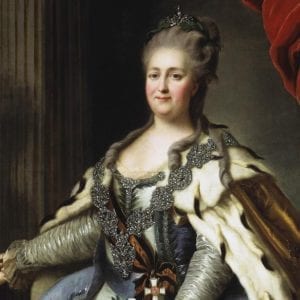
People often ask us who the greatest Shady Lady was. And it’s a hard question, because there are lots of possibilities: famous royal mistresses like Diane de Poitiers or Madame de Pompadour, famous courtesans like Marie Duplessis (the original of the Lady of the Camellias and La Traviata) or Grace Dalrymple Elliott (whose splendid portrait by Gainsborough reigns over the Metropolitan Museum’s English gallery), and #scandalous women of more modern times, like Josephine Baker or Marlene Dietrich. But if we have to pick ONE, then it might have to be….the same woman we would call the greatest “Nasty Woman:” Catherine II of Russia, generally known as Catherine the Great.
Catherine was one of the great rulers of time. Among many other things, it was she who expanded the Russian Empire eastward into places like Lithuania and south to the Crimea. She was also a real intellectual and art lover and one of the great arts patrons of the 18th century: for 2 examples, she maintained a 15 year friendly correspondence with Voltaire, and the Hermitage museum is based on her enormous private collections.
But today she is remembered in the popular consciousness for her active sex life. In fact, we call her a “Nasty Woman, ” because if you ask the man on the street, the one thing he will tell you is a crazy, misogynistic rumor, that she had a taste for sex with horses—a slanderous insult based on her long line of royal “favorites,” and perhaps on a view of Russians as barbarians (though in fact Catherine, born Sophie von Anhalt-Zerbst, was from northern Germany and only came to Russia to marry her equally German cousin, the then future Tsar Peter III).
But she certainly did live a life of #sexual #freedom unimaginable for most women before the 20th century. In fact, we would say she carried on very much like a male monarch of the period, with a long line of lovers sharing her bed before and throughout her reign. It is usual to connect this to her unhappy early sex life: her marriage to Peter III was very unhappy and possibly never consummated (though it seems most likely that her successor, Tsar Paul, was her child by her husband, as he resembled him both in appearance and character). It may also have affected her when her predecessor (and aunt) Empress Elizabeth took her children away from her at birth and raised them herself while allowing Catherine very little contact.
But we think it is more likely that she simply decided that, having eliminated (whether intentionally or not) her husband and the only other plausible pretender to the throne, she preferred to reign herself and so never married. Among other things, with the possible exception of Grigory Potemkin (another brilliant and astonishingly effective person who is remembered largely for scurrilous rumors), her lovers were not at her level of intelligence, rationality, and/or practicality, so it was better for her to keep power in her own hands.
In any case, she carried on her sex life very much in the same way contemporary kings like Louis XV of France did: she was never without a lover, alternating between brilliant and capable men, like Potemkin—the equivalent, say, of Madame de Pompadour—and spoiled, handsome boy-toys, like her last lover, Platon Zubov, who was *40* years her junior—the equivalent of Madame du Barry.
The difference is that while Louis XV was a terrible king and substantially worsened the economic and financial crisis that led to the French Revolution, Catherine was a brilliant ruler who greatly increased her country’s size and power. And also, while people remember Louis’ mistresses as style icons, Catherine is remembered for her sex life, as if there were something wrong with her having one. Whereas instead, we honor her as the greatest of all the Shady Ladies.