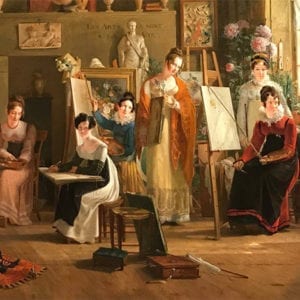
This picture shows us a transitional moment in the status of women in the arts. We see a group of women studying in an artist’s studio, which is of course relatively modern, as there were no studios where groups of women studied before the mid-18th century, even in Paris. (more…)
Author: Professor Andrew Lear

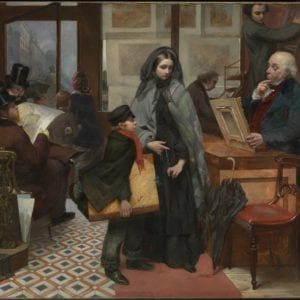
Seen at the Tate: Nameless & Friendless by Emily Mary Osborn 1857
Emily Mary Osborn was one of the most important artists associated with the campaign for women’s rights in the nineteenth century. The daughter of a clergyman, she was brought up in Kent and Essex until 1842 when the family moved back to London. It was here that she trained as an artist at Dickinson’s academy in Maddox Street and then at Leigh’s in Newman Street. During the 1850s Osborn established a reputation as a genre painter specialising in figurative subjects of ‘unpretending character’ – the most significant of which were pictures of modern women in pathetic situations, similar to works by Richard Redgrave and Rebecca Solomon. Home Thoughts, which was painted in 1856 and exhibited at the Royal Academy that same year, was followed by her most famous work Nameless and Friendless in 1857. A full-scale, squared-up preparatory design for the latter exists in the Ashmolean Museum in Oxford and a smaller version in oil in York Art Gallery.
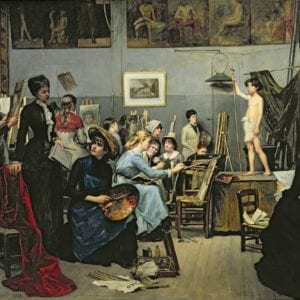
(more…)Marie Baltshirtseff: In The Studio

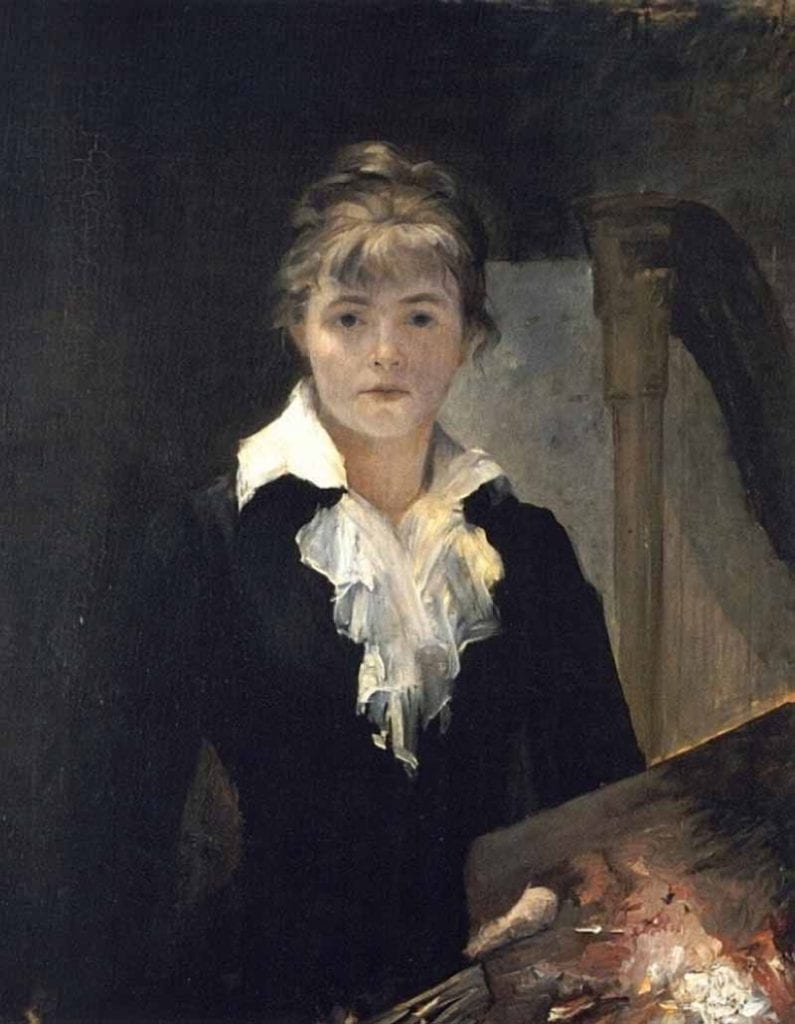
Marie Bashkirtseff The self-portrait is probably the most interesting tradition among women artists. Often women artists portray themselves as artists, or rather claim their status as an artist though self-portraiture; paintings of other women artists painting are a related tradition, involving a kind of vicarious self-portraiture. This painting gives us both sides of the tradition: the artist, Marie Baltshirtseff, is in the foreground, but we also see a whole studio of women art students.
It also shows us a key space in the history of women in the arts: the Académie Julian, one of the only places in 19th century Paris that gave rigorous training to women artists and consequently the alma mater of many women painters, such as Cecelia Beaux (but also non-French artists in general, e.g. John Singer Sargent). Though the Académie Julian allowed women to study nudes (at least semi-nudes), it was considered too scandalous for male and female students to paint nudes together; as a result, we see an all-female class in this scene, painting a semi-clothed boy posing as St. John the Baptist. Interested in the history women artists? Come on the Nasty Women tour of the Metropolitan!19th Century Painter Rosa Bonheur
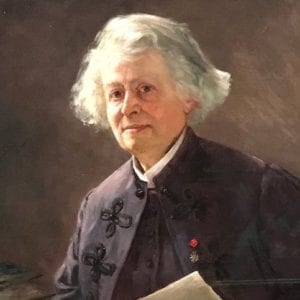
One of the great animal painters of the 19th century, Rosa Bonheur, portrayed by her life-partner, the American painter Anna Klumpke. For once, Bonheur is wearing women’s clothing, but her gown’s monochrome simplicity and its jacket-like bodice, along with her strong features and lack of make-up, coiffure etc. certainly make her somewhat gender-ambiguous. In fact, it’s hard to say what modern category (if any) Bonheur fit in. A trans activist recently suggested to me that she may have been intersex, which I consider interesting. Whatever the case was, however, she certainly was an early example of a modern, unmarried career woman—and the painting absolutely conveys her strength and independence.
Are They Thinking About the Grape?
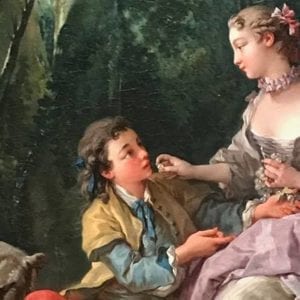
In this painting the artist is telling you just what Professor Lear says so often, that the painting is intended as sexy. You might think that the kind of shepherd-love fantasy that the painting portrays is inherently innocent, but if you look at it, you might notice signs of erotic heat, particularly in the facial expressions. And Boucher makes clear that the scene is not innocent by calling it, “Are They Thinking About the Grape?” I guess not then…. Want to see learn more about the sexy side of great art? Come on the Shady Ladies of the MFA tour, and while you are there, catch the “Casanova’s Europe” exhibit, with this painting among many other fun ones! Learn more bit.ly/2wE18i9
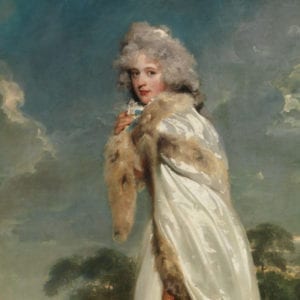
Comic Actress Elizabeth Farren
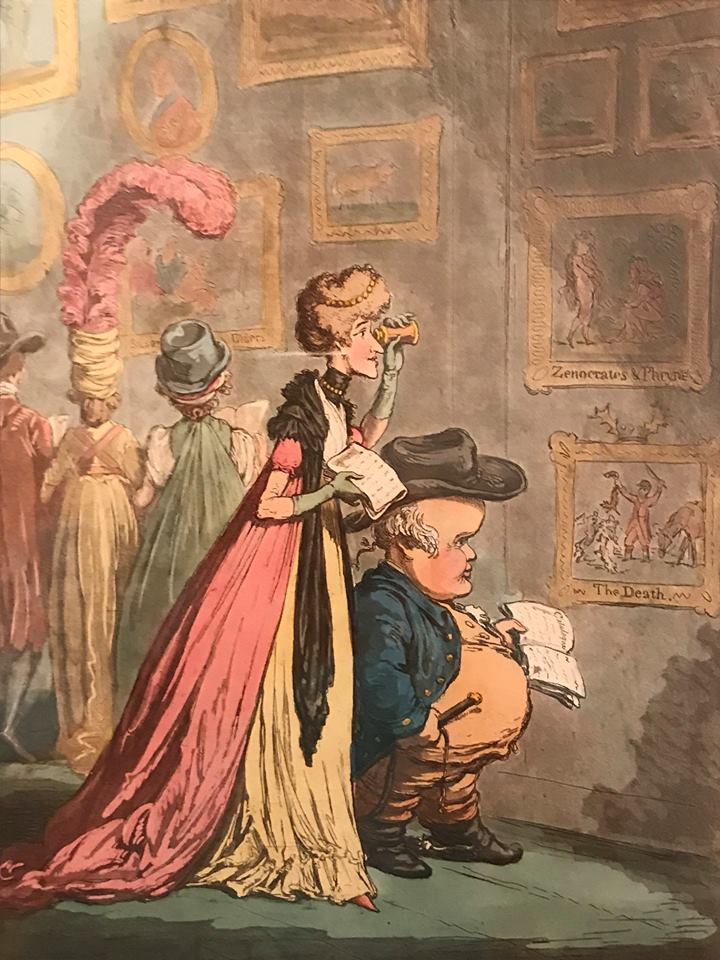
Elizabeth Farren was the great comic actress of 18th century London. She was the mistress of the Earl of Derby and when his wife died, he married her, so she became the Countess of Derby. Don’t imagine that this put their relationship beyond the aim of jokes, cartoons, etc. Quite the opposite: they were favorite objects of every kind of lampoon, as in this cartoon by Thomas Rowlandson, which emphasizes Farren’s height and Derby’s shortness…. Curious about the Shady Ladies of history? Come on our tours of the Metropolitan Museum of Art, and have fun while learning about them….

Fashion History in Art
We have been giving fashion history tours at the Metropolitan Museum for several months now, and the more we work on them, the more we see that fashion history is probably the biggest theme in the entire museum. If you think about it, you might think thathttps://shadyladiestours.com/fashion-and-beauty-tour/beauty—human beauty—is the biggest theme in the art history. But if you look carefully at the beautiful people in the museum, you will see that (aside perhaps from the Greek male nudes), the person’s features are only a secondary aspect of the images. It isn’t their natural beauty that makes people beautiful in art. Instead, the artworks focus on many other aspects of the beautiful person: on hairdos and make-up and jewelry and clothing and accessories and shoes. In short, human beauty in art consists not of beautiful features, but of costume or fashion. (more…)
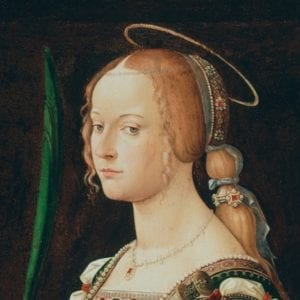
Why were high foreheads once considered a sign of beauty?
This painting portrays Saint Justina of Padua as a Renaissance fashion plate. The pearls, rubies, and emeralds sewn onto her clothing, cap, and hair tie were the mark of an aristocratic lady; her embroidered stomacher (the triangular piece covering chest and stomach) was the height of fashion, as were her elegant green sleeves (as in the song!), separate from her bodice, with the blouse pulled through the gaps in a style called ‘slashing’. Most noticeable to a modern eye is her amazingly high forehead. (more…)
Courtesans and mistresses in art
Elegant women are a huge theme in art history, and people mostly assume, as they stroll through art museums, that they are looking at queens, duchesses, and the wives of the wealthy. But often enough, they aren’t. They are looking at royal “favorites,” mistresses, and courtesans. Courtesans are in fact a particularly large theme in art, probably bigger than queens and duchesses. But people today pass by them without realizing who or what they were, because courtesans, if they exist today, are not important in our culture, so we’re unaware of them. (more…)
The feminist concept of the “male gaze”
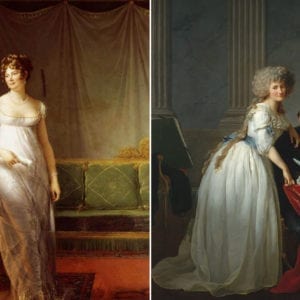
The feminist concept of the “male gaze” is useful in art criticism. The concept originally comes from film studies, where it is used to discuss the fact that men traditionally controlled the camera, of which women were an object. Men certainly also controlled the brush through most of the history of Western painting, and the women in paintings generally acknowledge this. As the art historian John Berger said, women in painting don’t usually look out at the viewer: they aren’t considering the viewer, but considering how the viewer sees them. They have an inward gaze, rather than an outward gaze. But painters can also violate this “rule” (more a tendency really) to depict a woman who has power or confidence.
Two paintings that are diagonally across from each other at the Metropolitan Museum make this clear. On the one hand, we have Gérard’s portrait of the Princess of Talleyrand, a courtesan who became Talleyrand’s mistress and then his wife. She was considered very beautiful in her time and is dressed in the latest Empire fashions, and she looks down and to the side in her portrait. Her gaze avoids the viewer’s: she is absorbed in her own thoughts, or her own coquetry, it’s unclear which. Across the gallery is David’s double portrait of the great scientist Lavoisier and his wife, Marie-Anne Paulze. Here the male inside the painting definitely does not control the gaze: he looks up at his wife questioningly, while she does not return his gaze (though she puts her hand on his shoulder with a gesture of intimacy unusual in painting). Instead she turns to look out directly and confidently (though not aggressively) at the viewer: it is she who communicates with the world on behalf of this couple. And in fact this portrays something real about this couple. Paulze had many public-facing characteristics that Lavoisier lacked: she spoke many languages and could inform Lavoisier about the scientific literature of the whole of Europe. And she was also his lab illustrator, explaining his/their experiments to the world through the visual arts. Look at the women you see in the art museum the next time you go. Do they look out at the viewer, or not, and why?
https://www.facebook.com/events/724999504353889