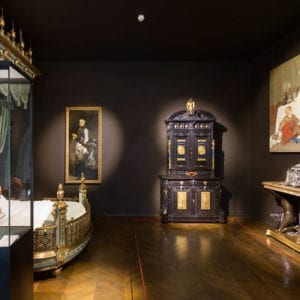
Paris is the city of love, and the Louvre is its centerpiece. Learn about the theme of love in this palace full of masterpieces! The Louvre is full of love stories, because all through the centuries, love has inspired French artists. Discover the love secrets of France’s Kings behind magnificent Renaissance sculptures.
The Louvre’s masterpieces will teach you how passion almost destroyed the country during the Wars of Religion.
Find out about the erotic passions of the Libertines in the century of The Dangerous Liaisons.
Learn how the love between a famous painter and his model tells the bloody history of the French Revolution. See how the love of power united Napoléon & Joséphine, and how Romantic love inspired the salonniere Juliette Récamier & the poet Chateaubriand.
In short, you can experience a whole history of love through the galleries of Paris’ great art museum!
At the end of this very real annus terribilis, I want to say a few words to you, our loyal readers and attendees. Above all, thanks! Thanks for keeping Shady Ladies Tours alive by reading our blog, attending our Zoom tours, watching our YouTube videos, contributing to our fundraisers—in short, for being a fabulously loyal community. When the pandemic hit the US, in March, it seemed likely to kill the company completely. Who would have thought that 9 months later, as the pandemic continued to rage, we would be putting on our 18th Zoom tour, with audiences regularly over 100, and have gathered over 28,000 views for our videos? It’s been a hard year, but ours is a tiny, flourishing corner. And we have a lot more coming after the holidays! Want to find out more? (more…)
Bold and sexy women must always have existed everywhere, but in history they seem to be a French specialty. There are a number of places where you can learn about them in Paris. The Louvre and Orsay museums are great, for instance, or the royal palace at Versailles. But if you are interested in the colorful sides of Paris women’s history, don’t miss Père Lachaise Cemetery!
Père Lachaise, founded under Napoleon in 1804, was Paris’s first non-sectarian cemetery. It was also the first garden cemetery, a 19th century trend that brought us London’s so-called Magnificent Seven cemeteries, New
Père Lachaise Cemetery
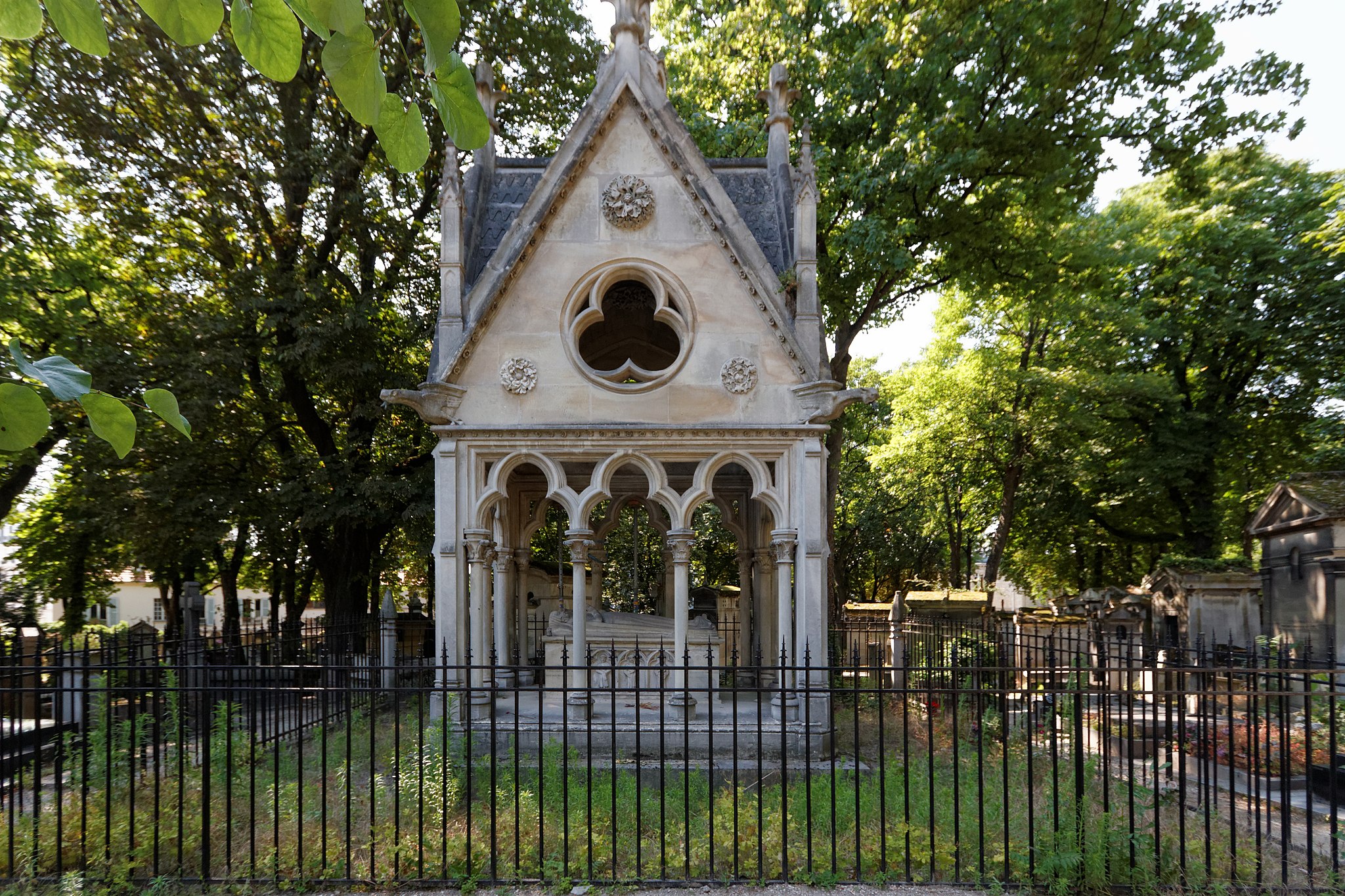
York’s Green-wood, Boston’s Mount Auburn, and so on. These cemeteries were intended as parks, where the public could stroll and even picnic. And one of the attractions (aside from groves, ponds, etc) was meant to be the magnificent tombs of well-known people. Indeed, the founders of Père Lachaise jump-started this aspect by transferring some famous tombs there, including the one you see above. Thus is the joint tomb of the iconic romantic couple of the Middle Ages, theologian Abélard and his abbess wife Héloïse.
And they were certainly successful in attracting the tombs of the prominent—including many prominent women. There are certainly famous men in the cemetery, such as (to start with composers) Chopin, Rossini, and Bizet. And the two most visited tombs are those of English-world celebs Oscar Wilde and Jim Morrison. Yet there are many fascinating women buried here as well. A short list would be long but would have to include: Sarah Bernhardt, Isadora Duncan, Gertrude Stein and Alice B Toklas, Colette, Maris Callas, and Edith Piaf. These are the kind of bold and sexy women that makes Paris women’s history so special and intriguing.
Here are three of my favorite tombs in Père Lachaise. Two are of women, and one is (as I will explain) important to Parisian women.
The racy writer
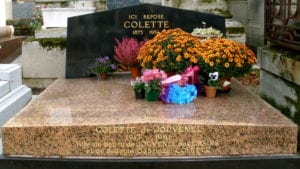
I’ll start with one from my list above: the tomb of Colette, which is right near the main
Colette’s tomb
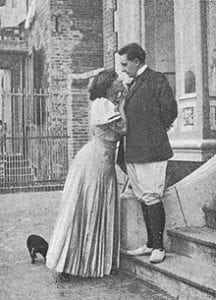
entrance to the cemetery. Colette was an astonishing person. She is probably the most famous French woman writer today. Her four early Claudine novels are very popular in France. And her last book, Gigi, is well-known around the world—mainly, no doubt, because of the movie, starring Audrey Hepburn—whom Colette herself discovered. She was also a racy person. After she had left her first husband (who discovered her gift for writing but kept the copyrights to her first books for himself) she created a scandal by carrying on an affair with a cross-dressing aristocrat called Mathilde de Morny, and generally known at the time as Max or uncle Max. The scandal reached its peak when Colette and Max
Colette and Max
kissed on stage at the Moulin Rouge—a pretty bold gesture for 1907! Colette kept most of her raciness for her writing, however, in which her biggest themes are lesbianism and courtesans—the high class sex workers who were so important in Belle Epoque Paris’s life and of whom Colette’s Gigi is the most famous example.
The cross-dressing painter
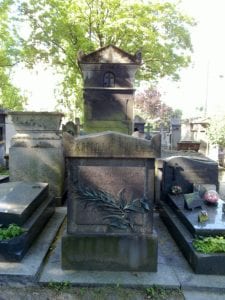
A thruple in death: Ducas, Bonheur, Klumpke
Next is another tomb of a bold and racy woman, the painter Rosa Bonheur. Bonheur is not famous today, but before the Impressionists began the turn toward abstraction that typifies modern art, she was a big star of the art world. An example in an American museum is the vast hyperrealistic The Horse Fair that fills a wall at the Metropolitan Museum.
Bonheur probably interests modern viewers more as a personality than as an artist, though. She was one of those artistic 19th century women who lived her life in households consisting of two women—what today historians call ‘Boston marriages.’ It is impossible for us to know what went on in private, but one tends to assume that the women in these ‘marriages’ were mostly what today we would call lesbians. But Bonheur was not only probably a lesbian, she was also what we would call gender-queer. She was strikingly non-feminine and often dressed in men’s clothing. She lived in two Boston marriages: the first with a woman called Nathalie Ducas, the second (after Ducas’s death) with an American painter called Anna Klumpke.
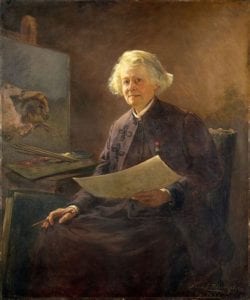
Bonheur by Klumpke
I am giving you two pictures. One is a striking portrait of the elderly Bonheur by Klumpke, the other the Ducas family tomb, where not only Nathalie is buried, but also Bonheur and Klumpke both (as you can see from the plaques on the front).
The fertility cult
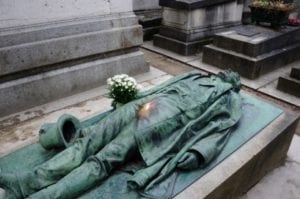
Finally, let me show you one of the sights every Parisian knows in the cemetery: the tomb of Victor Noir. Noir a young left-wing journalist who was shot by Prince Pierre Bonaparte, and his tomb long served As the center of many left-wing rallies. You might think you’re seeing things, but no, that really is a realistic death erection in his trousers,
Victor Noir’s tomb
and yes, it is rubbed clean of verdigris. If you look carefully, you can see that his lips are also clean. That is because Victor, with his erection, serves as a fertility cult place-of-worship for Parisian women who want to pray to find a boyfriend, get pregnant etc. The tradition is that you kiss his lips, leave flowers in his hand (as you can see in the photo) or hat and rub his erection. I have heard from some gay friends that they pray to Victor Noir as well!
So if you want to know about Paris women’s history—the history of bold and sexy women that really is one of the things that makes Paris Paris—don’t only visit the museums and Versailles. Take a stroll around Père Lachaise as well! Or, if you can’t go to Paris (because none of us can go anywhere right now!) take Shady Ladies Tours’ Père Lachaise tour on Zoom the next time we offer it.
Paris is the great city for the history of racy women. Certainly, other places have contributed—particularly Italy during the Renaissance. But from the time the Renaissance took off in France, scandalous French women have taken most of the world prizes for raciness. (more…)
Elegant women are a huge theme in art history, and people mostly assume, as they stroll through art museums, that they are looking at queens, duchesses, and the wives of the wealthy. But often enough, they aren’t. They are looking at royal “favorites,” mistresses, and courtesans. Courtesans are in fact a particularly large theme in art, probably bigger than queens and duchesses. But people today pass by them without realizing who or what they were, because courtesans, if they exist today, are not important in our culture, so we’re unaware of them. (more…)
One of my favorite things to do in Paris—really—is explore the cemeteries. The most famous one is Père Lachaise, where a host of celebs are buried, including most famously Oscar Wilde and Jim Morrison. But it is also a great place for learning about the great courtesans of the Belle Epoque. As an example, Chopin is buried there, the lover of George Sand—a scandalous lady if ever there was one—and so is Colette, in whose novels, such as Gigi and Chéri, courtesans are a major theme. But the great cemetery for Paris courtesans is really Montmartre, which is also a lovely place to take a shady, quiet walk in central Paris—right around the corner from the Moulin Rouge —so we take our Shady Ladies ToursCourtesans of Paris tour there, as you can see in the feature photo. (more…)
Every Paris tour should include some major sights: even if you’ve seen them before, you can always see new sides. Plus some wonderful food of course. Our Shady Ladies Paris tour includes both of those, with a “Shady Ladies” tour of the Orsay Museum highlighting the racy sides of the collection (on the model of our well-known tour of the Metropolitan) and some truly excellent meals; also a tasting at the patisserie that is most famous for macarons. But we also include a bunch of sights in our Paris tour that you probably haven’t seen—lesser-known sights that even Parisians think it would be cool to see. (more…)
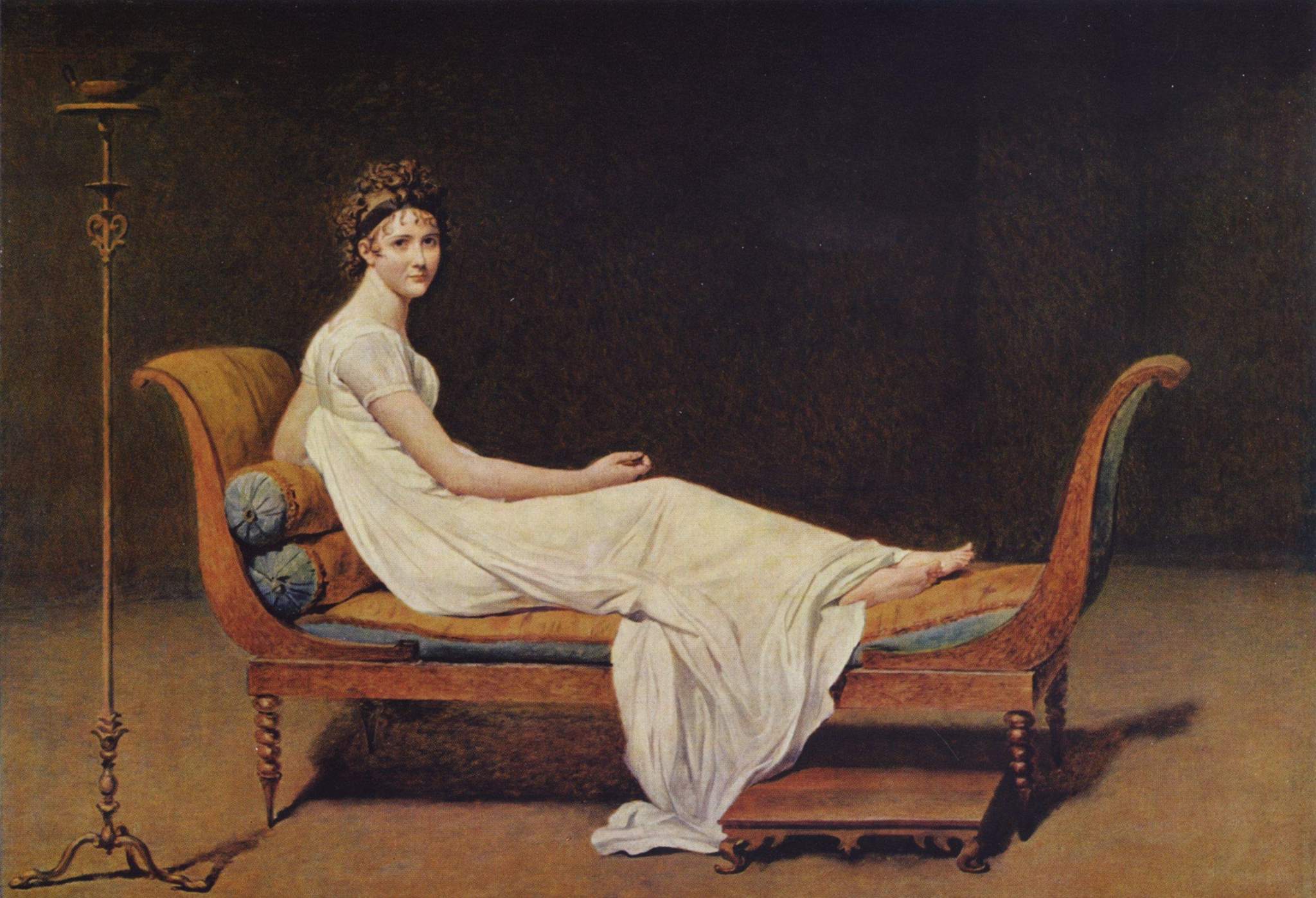
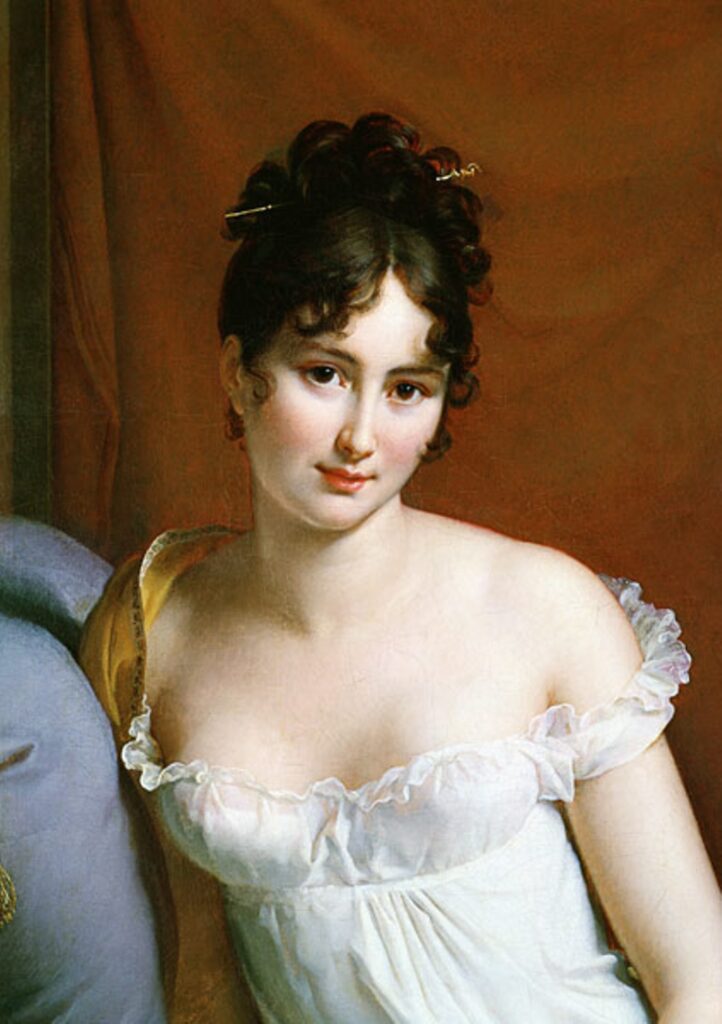 Paris is the city of love, and the Louvre is its centerpiece. Learn about the theme of love in this palace full of masterpieces! The Louvre is full of love stories, because all through the centuries, love has inspired French artists. Discover the love secrets of France’s Kings behind magnificent Renaissance sculptures.