Category: Paris

  • Frédéric Chopin and George Sand

    Frédéric Chopin and George Sand

    Based in part on a Shady Ladies lecture by Edith de Beauville and historian Professor Andrew Lear

    George Sand (born Amantine Lucile Aurore Dupin-1804-1876), was one of the most popular writers of her era, respected and befriended by peers Honoré de Balzac, Victor Hugo, Gustave Flaubert, Ivan Turgenev, and Alfred de Musset (with whom she had an affair prior to Frédéric Chopin).  Sand lived with extraordinary personal and professional freedom at a time women were bound to their homes and husbands by both society and Napoleonic law.
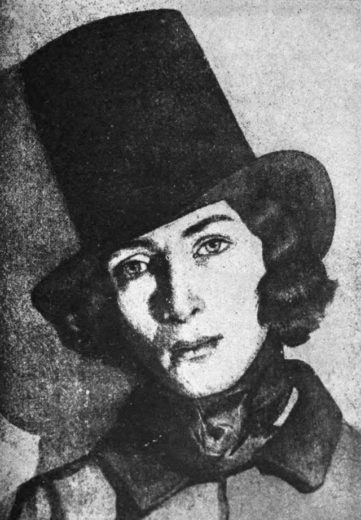
    Portrait of George Sand en costume mascilun (Public Domain)

    Aurore’s father died when she was four. Her mother, apparently mentally unbalanced, turned the child over to a grandmother who raised her. In order to escape being placed in a convent, at 18 she married Francois Casimir Dudevant and would bear him two children, Solange and Maurice. The marriage was a disaster, her husband an unfaithful bully.

    A year later her grandmother died. In France at the time, one had to be 21 to achieve legal adulthood, but the girl managed to keep both house and inheritance without interference. Monsieur Dudevant lost no time in spending her money. As divorce had been outlawed, Aurore picked up and moved to Paris on her newfound funds, arranging six months with and without custody of the children. Both these exertions of women’s rights were unheard of.  Four years later, she would be the first woman in France to achieve legal separation.
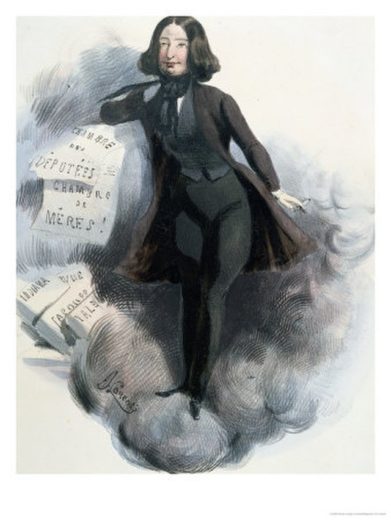
    Caricature George Sand 1848 (Axagore; Creative Commons Attribution Share Alike)

    Restrictions on women were nonetheless omnipresent. In order to move freely (and, she said, for both convenience and protection), Aurore began to dress as a man, a choice outlawed by police unless one was riding or had a doctor’s note. (Consequences of ignoring the law, however, were few and far between.) Victor Hugo commented, “George Sand cannot determine whether she is male or female. I entertain a high regard for all my colleagues, but it is not my place to decide whether she is my sister or my brother.” She also scandalously smoked in public.

    Aurore’s first book Rose et Blanche was a collaboration with writer Jules Sandeau (another affair). Its author was listed as “Jules Sand.” The second volume, Indiana, written alone, came out under the nom de plume George Sand. It centers on a young married noblewoman who suffers sequential illness presumably due to lack of passion. Seduction, adultery, life on an island (shades of things to come) and a suicide pact which is thwarted by love make this a perfect romance novel. Women were drawn not only to that aspect, but also its spirited female independence. Her reputation was made.

    A series of affairs ran tandem with prolific writing. Sand’s last known relationship was with her son’s best friend 15 years her junior. It lasted 15 years until her death. She died at 72 and is buried behind the chapel at Nohant.
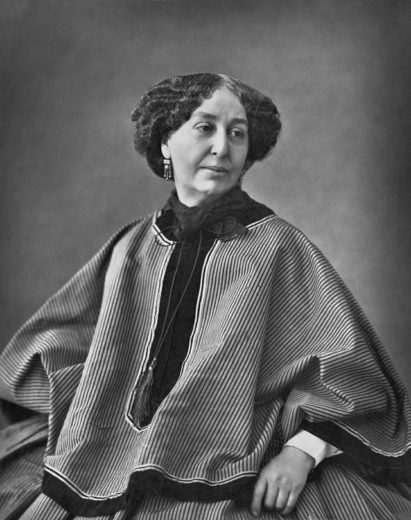
     

    George Sand by Nadar 1864 (Public Domain)

    1836, the first of several compendia was published in 24 volumes. This included literary criticism, political texts (She was a member of the provisional government of 1848 and wrote about the Paris Commune of 1871) and autobiographical pieces Histoire de ma vie (1855), Elle et Lui (1859, about her affair with Musset), and Un Hiver a Marjorque (about her life in Majorca with Chopin).  In 1880, her children sold the rights to her literary estate for 25,000 Francs. Still, she may be better known for her lifestyle.


    Born in Warsaw, Poland, Frédéric François Chopin (1810-1849) began playing piano at age six. A year later, running just behind Mozart’s year-old accomplishment, he wrote and performed his first compositions, the polonaises in G minor and B flat major. His piano teacher saw to it the prodigy attended music school and at a young age Chopin began giving concerts.

    At 20, as his country erupted in war, he moved to Paris.The pianist/composer would offer only 30 public performances in his life. Those privileged to hear him live attended private salons. Income was garnered by giving piano lessons and selling compositions. Otherwise affianced for a single year (history suggests the two were never lovers), the sickly Chopin (like his sister he would die of tuberculosis) is not associated with another woman besides George Sand.

    When Chopin met Sand, they were both respectively staying at the house of mutual friend, Franz Liszt. According to de Belleville, the author was in her usual male attire. “What an unattractive person la Sand is. Is she really a woman?” Chopin  commented. (Jim Samson on Chopin – Oxford University Press) The musician was conservative and a snob. The writer, in turn, initially found her incipient lover frail and rather feminine. A year later, setting her cap for the younger man (all her lovers were younger), Sand wore the finery of her sex and seduced him.

    Photo of Frédéric Chopin 1847 (Public Domain)

    She was apparently surprised at his effect on her. It’s a testament to Sand’s devotion to the man and his art that she financially supported and nursed the increasingly ill Chopin for nine years, long after they stopped having sex. Madame was still married. In order to escape prying eyes, she took Chopin to Majorca (with her children) even importing a superb Pleyel piano.

    Their ill-timed, under researched stay was doomed. It was winter. Living conditions were harsh exacerbating instead of helping Chopin’s illness. Catholic locals banded together against the unmarried couple (who didn’t attend church) and overcharged for everything. Sand’s funds ran thin. Chopin coughed up blood. They began to fight. (The couple couldn’t leave because sailing was dangerous during the season.) Despite all this, under her care, 24 preludes were composed.

    Fryderyk Chopin 1892 (Public Domain)

    Finally able to travel, the two went to Barcelona, Marseilles and finally Sand’s home in France, Nohant. The music room was lined in cork so creativity wouldn’t be hampered by sound. Sand now called Chopin her “third child.” She published the novel Lucrezia Floriani, whose main characters – a rich actress and a prince in weak health – could be stand-ins for the couple.

    At this point, her daughter Solange married a man De Belleville describes as mercenary. George had a falling out with her while Chopin evidently took the girl’s side. It tipped the balance and the composer left. He made his last appearance at London’s Guildhall in a benefit for Polish refugees and died a year later at age 39. Frédéric Chopin is buried in Paris’s famous Père-Lachaise Cemetery. Over 230 works of music survive.

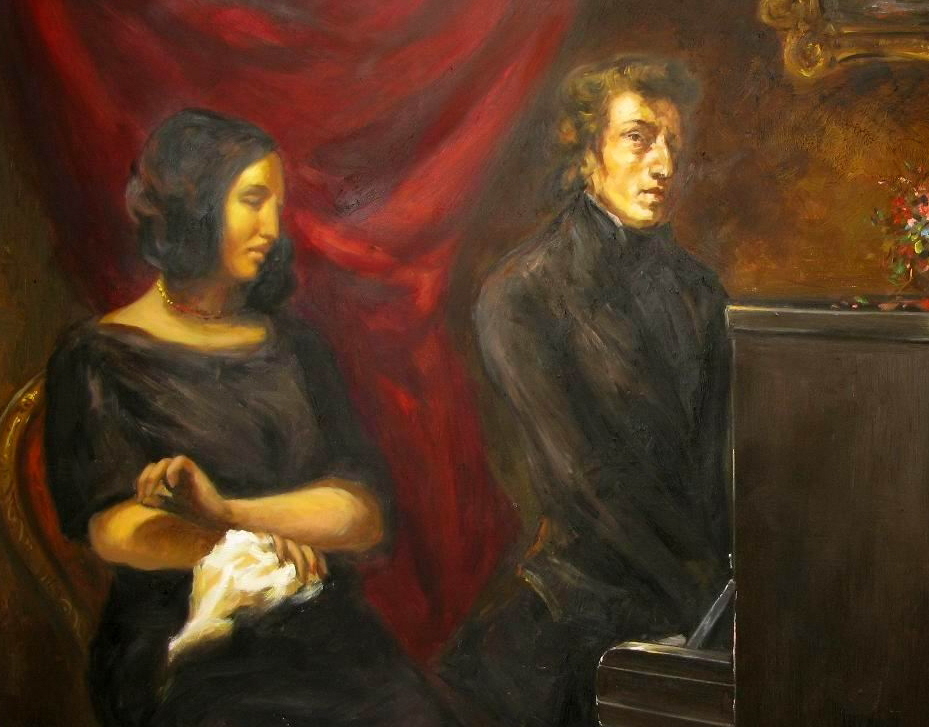
    Opening: George Sand and Frederic Chopin by Eugene Delacroix- (Public Domain)

    Films: Impromptu, George Sand’s meeting with Chopin- Prime video

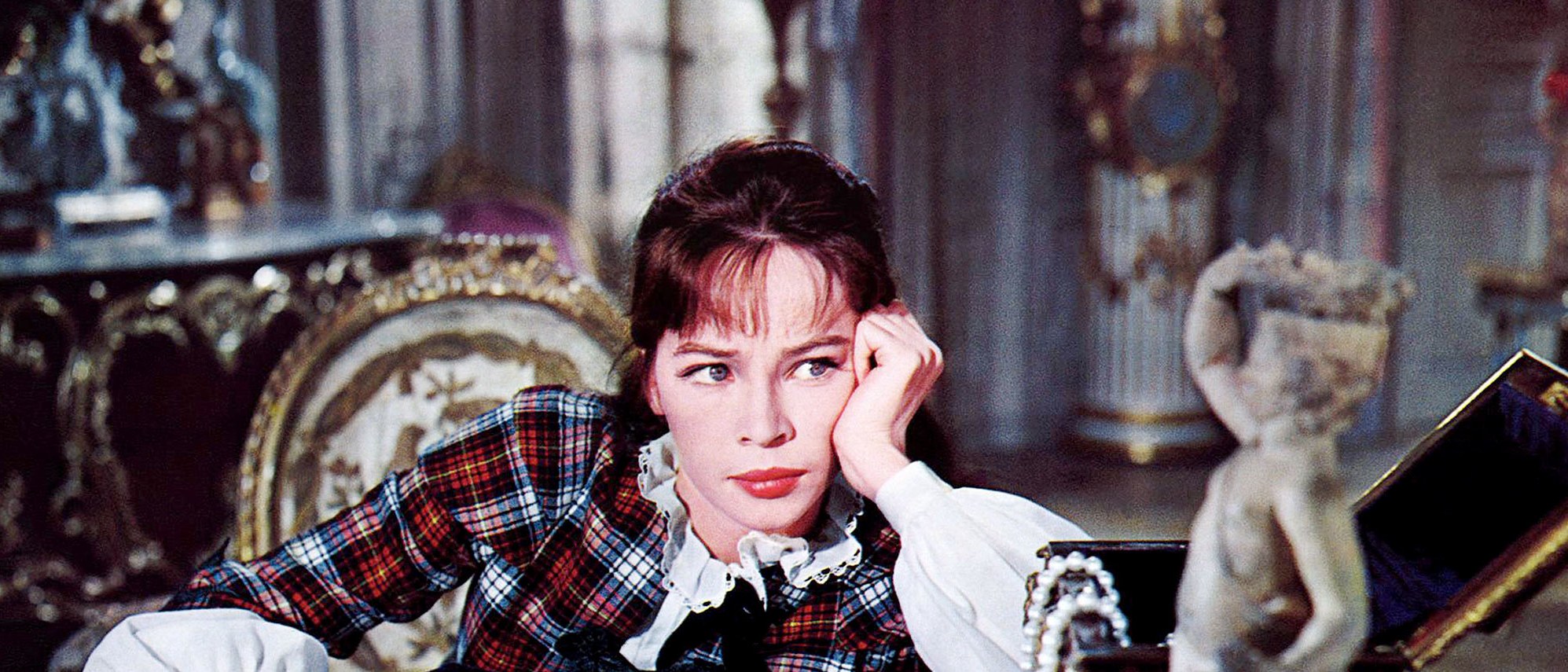
    Children of the Century, a film about George Sand and Alfred de Musset

    Chopin: Desire for Love

    All taken with a grain of salt

    Learn about the fascinating women of the past—shady ladies, nasty women, fashion icons—in  fun and revealing tours of the world’s great cities and museums 

    Coming UP: Saturday March 5:  The Gender Rebel Woman Painter of mid-19th Century New York, with Rena Tobey

    Renoir’s Women with Edith Belleville (March 12) and Scandals and Secrets of Britain’s Stately Homes with Professor Andrew Lear (March 19)
    Article written by Alix Cohen

  • Love in the Louvre Zoom Tour of the  Metropolitan

    Love in the Louvre Zoom Tour of the Metropolitan

    Paris is the city of love, and the Louvre is its centerpiece. Learn about the theme of love in this palace full of masterpieces! The Louvre is full of love stories, because all through the centuries, love has inspired French artists. Discover the love secrets of France’s Kings behind magnificent Renaissance sculptures.

    The Louvre’s masterpieces will teach you how passion almost destroyed the country during the Wars of Religion.

    Find out about the erotic passions of the Libertines in the century of The Dangerous Liaisons.

    Learn how the love between a famous painter and his model tells the bloody history of the French Revolution. See how the love of power united Napoléon & Joséphine, and how Romantic love inspired the salonniere Juliette Récamier & the poet Chateaubriand.

    In short, you can experience a whole history of love through the galleries of Paris’ great art museum!

    Click  Here: NEXT TOUR: November 6th @ 2 PM Eastern

  • Zoom Tours in 2020 and 2021

    Zoom Tours in 2020 and 2021

    At the end of this very real annus terribilis, I want to say a few words to you, our loyal readers and attendees.  Above all, thanks!  Thanks for keeping Shady Ladies Tours alive by reading our blog, attending our Zoom tours, watching our YouTube videos, contributing to our fundraisers—in short, for being a fabulously loyal community.  When the pandemic hit the US, in March, it seemed likely to kill the company completely.  Who would have thought that 9 months later, as the pandemic continued to rage, we would be putting on our 18th Zoom tour, with audiences regularly over 100, and have gathered over 28,000 views for our videos? It’s been a hard year, but ours is a tiny, flourishing corner.  And we have a lot more coming after the holidays!  Want to find out more? (more…)

  • Paris Women’s History in Père Lachaise

    Paris Women’s History in Père Lachaise

    Bold and sexy women must always have existed everywhere, but in history they seem to be a French specialty.  There are a number of places where you can learn about them in Paris.  The Louvre and Orsay museums are great, for instance, or the royal palace at Versailles.  But if you are interested in the colorful sides of Paris women’s history, don’t miss Père Lachaise Cemetery!

    Père Lachaise, founded under Napoleon in 1804, was Paris’s first non-sectarian cemetery.  It was also the first garden cemetery, a 19th century trend that brought us London’s so-called Magnificent Seven cemeteries, New

    Paris women's history
    Père Lachaise Cemetery

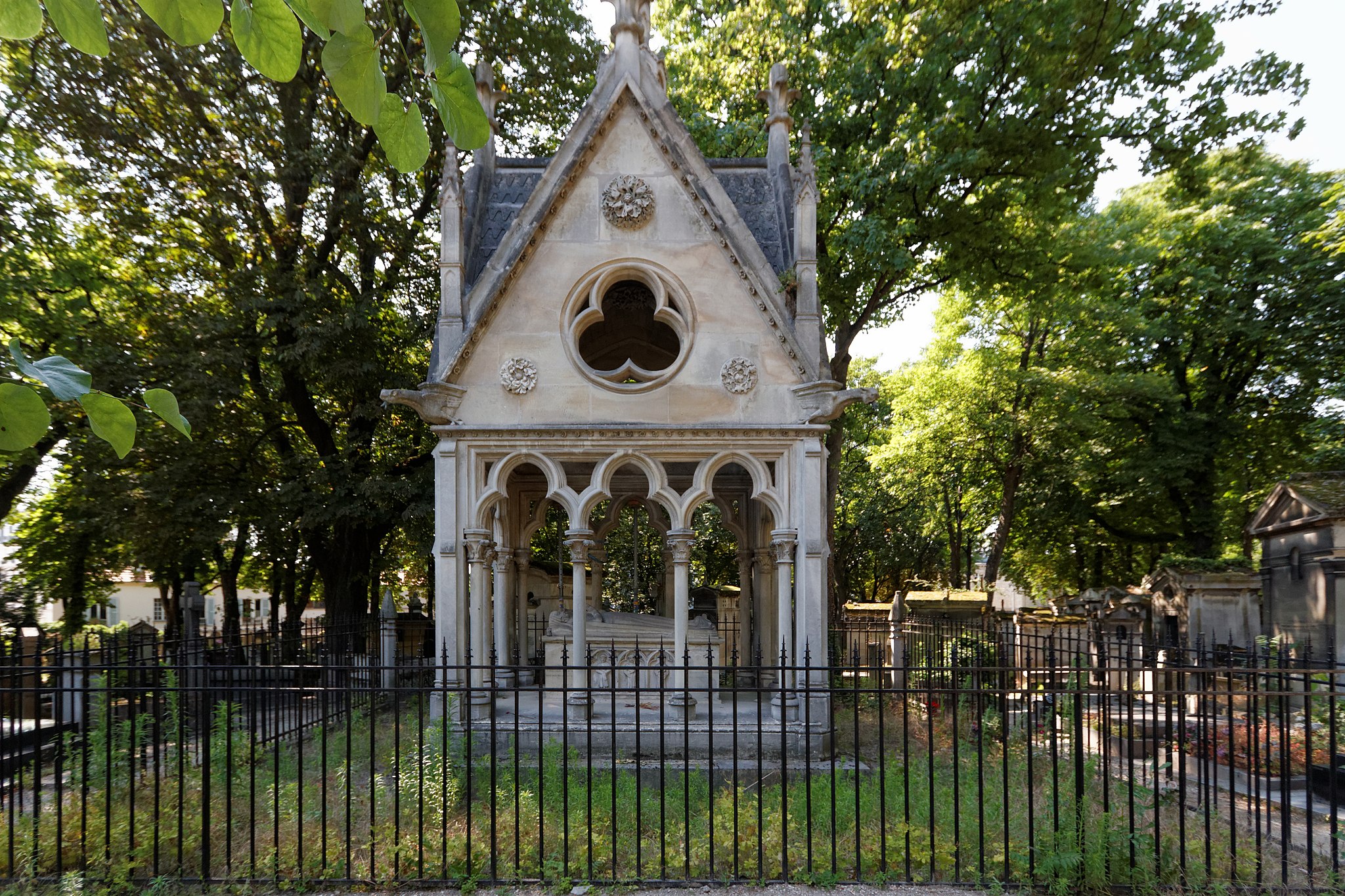
    York’s Green-wood, Boston’s Mount Auburn, and so on.  These cemeteries were intended as parks, where the public could stroll and even picnic.  And one of the attractions (aside from groves, ponds, etc) was meant to be the magnificent tombs of well-known people.  Indeed, the founders of Père Lachaise jump-started this aspect by transferring some famous tombs there, including the one you see above.  Thus is the joint tomb of the iconic romantic couple of the Middle Ages, theologian Abélard and his abbess wife Héloïse.

    And they were certainly successful in attracting the tombs of the prominent—including many prominent women. There are certainly famous men in the cemetery, such as (to start with composers) Chopin, Rossini, and Bizet.  And the two most visited tombs are those of English-world celebs Oscar Wilde and Jim Morrison. Yet there are many fascinating women buried here as well.  A short list would be long but would have to include:  Sarah Bernhardt, Isadora Duncan, Gertrude Stein and Alice B Toklas, Colette, Maris Callas, and Edith Piaf.  These are the kind of bold and sexy women that makes Paris women’s history so special and intriguing.

    Here are three of my favorite tombs in Père Lachaise.  Two are of women, and one is (as I will explain) important to Parisian women.


    The racy writer

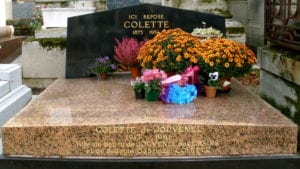
    I’ll start with one from  my list  above:  the tomb of Colette, which is right near the main

    Paris women's history
    Colette’s tomb

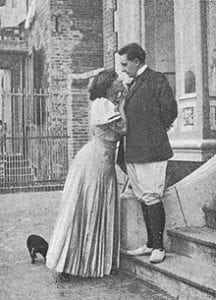
    entrance to the cemetery.  Colette was an astonishing person.  She is probably the most famous French woman writer today.  Her four early Claudine novels are very popular in France.  And her last book, Gigi, is well-known around the world—mainly, no doubt, because of the movie, starring Audrey Hepburn—whom Colette herself discovered.  She was also a racy person.  After she had left her first husband (who discovered her gift for writing but kept the copyrights to her first books for himself) she created a scandal by carrying on an affair with a cross-dressing aristocrat called Mathilde de Morny, and generally known at the time as Max or uncle Max.  The scandal reached its peak when Colette and Max

    Paris women's history
    Colette and Max

    kissed on stage at the Moulin Rouge—a pretty bold gesture for 1907!  Colette kept most of her raciness for her writing, however, in which her biggest themes are lesbianism and courtesans—the high class sex workers who were so important in Belle Epoque Paris’s life and of whom Colette’s Gigi is the most famous example.

    The cross-dressing painter


    Paris women's history
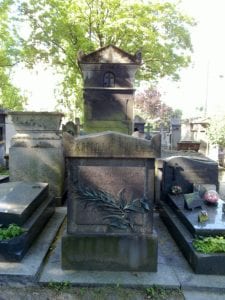
    A thruple in death: Ducas, Bonheur, Klumpke


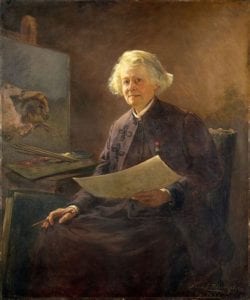
    Next is another tomb of a bold and racy woman, the painter Rosa Bonheur.  Bonheur is not famous today, but before the Impressionists began the turn toward abstraction that typifies modern art, she was a big star of the art world.   An example in an American museum is the vast hyperrealistic The Horse Fair that fills a wall at the Metropolitan Museum.

    Bonheur probably interests modern viewers more as a personality than as an artist, though.  She was one of those artistic 19th century women who lived her life in households consisting of two women—what today historians call ‘Boston marriages.’  It is impossible for us to know what went on in private, but one tends to assume that the women in these ‘marriages’ were mostly what today we would call lesbians.  But Bonheur was not only probably a lesbian, she was also what we would call gender-queer.  She was strikingly non-feminine and often dressed in men’s clothing.  She lived in two Boston marriages:  the first with a woman called Nathalie Ducas, the second (after Ducas’s death) with an American painter called Anna Klumpke.

    Paris women’s history
    Bonheur by Klumpke

    I am giving you two pictures.  One is a striking portrait of the elderly Bonheur by Klumpke, the other the Ducas family tomb, where not only Nathalie is buried, but also Bonheur and Klumpke both (as you can see from the plaques on the front).


    The fertility cult

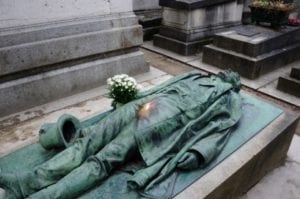
    Finally, let me show you one of the sights every Parisian knows in the cemetery:  the tomb of Victor Noir.  Noir a young left-wing journalist who was shot by Prince Pierre Bonaparte, and his  tomb long served As the center of many left-wing rallies.  You might think you’re seeing things, but no, that really is a realistic death erection in his trousers,

    Paris women's history
    Victor Noir’s tomb

    and yes, it is rubbed clean of verdigris.  If you look carefully, you can see that his lips are also clean.  That is because Victor, with his erection, serves as a fertility cult place-of-worship for Parisian women who want to pray to find a boyfriend, get pregnant etc. The tradition is that you kiss his lips, leave flowers in his hand (as you can see in the photo) or hat and rub his erection.  I have heard from some gay friends that they pray to Victor Noir as well!

    So if you want to know about Paris women’s history—the history of bold and sexy women that really is one of the things that makes Paris Paris—don’t only visit the museums and Versailles.  Take a stroll around Père Lachaise as well!  Or, if you can’t go to Paris (because none of us can go anywhere right now!) take Shady Ladies Tours’ Père Lachaise tour on Zoom the next time we offer it.


  • Scandalous French Women of History

    Scandalous French Women of History

    Paris is the great city for the history of racy women.  Certainly, other places have contributed—particularly Italy during the Renaissance.  But from the time the Renaissance took off in France, scandalous French women have taken most of the world prizes for raciness. (more…)

Check Out Our Upcoming

ZOOM TOURS

BOOK NOW