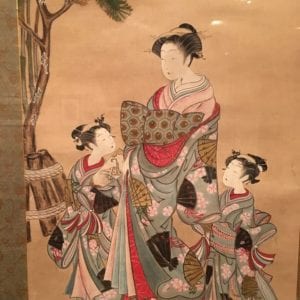
A couple of weeks ago I took a meander around the Met to see what new stuff was hanging–and what did I find? Lots of new courtesans! In particular, there is now a whole gallery of Japanese paintings of beautiful women–including a number of courtesans, such as this woman in a scroll from the 1780s by Isoda Koryusai. This painting seems to show the main street of the Yoshiwara, the ‘pleasure quarter’ of the city of Edo (modern Tokyo). A courtesan is promenading with her two assistants (or perhaps apprentices). She is the height of fashion, or perhaps overdone—as was apparently typical of these women—wearing multiple layers of elaborate kimonos, and the huge clogs which were typical of courtesans–clogs which made it impossible to walk naturally (a custom that reminds me of Chinese foot-binding). (more…)
Category: Shady Ladies

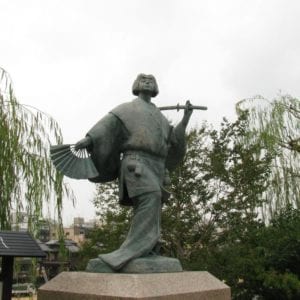
Izumo no Okuni
Izumo no Okuni did not find her fame in the elite pleasure houses of Kyoto, where women with elaborate artistic educations provided their clients with the most rarefied pleasures of fantasy-femininity and the most pragmatic pleasures of the flesh. Okuni was a miko, or shrine maiden, at the Grand Shrine at Izumo, a location that gave her a name. Shrine maidens developed skills in shamanic dancing and, often, equal facility as sex workers.
In the dancing part, Okuni excelled. Evidently, like her sisters higher in Kyoto’s sex-work hierarchy, she got some form of artistic education. Or perhaps she was just observant, ambitious, and stunningly creative. Around 1603, she launched a career as a public performer—really, what present-day people might call a busker. She picked a space and started dancing for money and attention. As she earned both, her performances became more elaborate, with more dancers and more musicians and drummers to accompany them. Encouraged, she began to give her dances stories, often daring ones. Some of her dances evolved from traditional folk and religious dance sequences, but she ventured into satire—sometimes impersonating the Shinto priests she had served in the temple, sometimes decking herself out in the regalia of a Christian priest. Her cross-dressing and portrayals of male characters were part of the transgressive thrill she delivered. In one of her pieces, it’s still remembered, she disguised herself as a man paying court to a courtesan.
Her operation morphed into a full-fledged dance troupe, wildly acclaimed. The new fusion form she’d created needed a name, and the one it got was kabuki—one of those Japanese words most people know, even if the other two are sushi and geisha. It comes from kabuku, a verb that means to frolic or to get wild and outrageous. Since she performed in Kyoto during its jaded decadence and scandalized her public regularly, her dances must have had a wicked erotic verve. The red-lantern district of Kyoto was not the easiest place to be transgressive.
Vibrant pictures of Okuni, cross-dressed for a performance, pay tribute to her daring. Her statue in Kyoto probably doesn’t look much like her—it was, after all, erected in 2003. Better late than never, though, when it comes to commemorating a woman who vaulted over the barriers of her time, class, and gender in a society that encouraged women to stay in their places.
Sammu Ramat Empress Regnant Assyria
In Rossini’s opera about her, Queen Semiramide of Assyria walks onstage right into a problem: The aristocratic politician who helped her poison her husband and usurp his throne wants her to fulfill her end of the bargain and nominate him to rule the nation. Payment due! (more…)
Spanish Opera Singer Maria Malibran
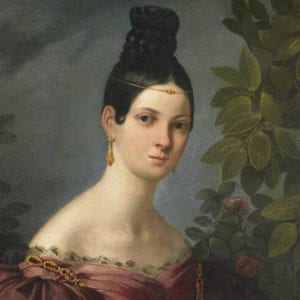
Maria Malibran entered the world in 1808 with an uncommonly interesting backstory and set of genes. Her father, the famous tenor Manuel Garcia, was probably half-Romany; her Spanish mother was a more minor opera singer. Garcia was a spectacular singer, a brilliant teacher, and a manic brute. Determined to make his daughter into one of the planet’s most brilliant vocalists, he battered and terrorized her regularly in service to this aim. Did she start life with a miraculous voice? She had one by the time she made her debut at a London concert at 16, just old enough to be a sophomore in a postmodern American high school. By that time, she already had a range from E below middle C to high C. At 17, she made her operatic debut as Rosina in The Barber of Seville to great acclaim. (more…)
Meet Nell Gwyn One Of History’s Most Famous Mistresses
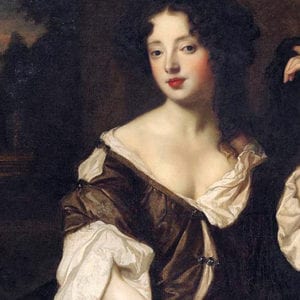
Nell Gwynn was born Eleanor Gwynn in 1650, in London and lived a meteoric thirty-seven years. Her mother ran a brothel, where young Nell tended bar until she was fourteen. Then she began selling oranges at the Drury Lane Theatre. Influential attention began before long; the leading actor there, Charles Hart, took the impish nymphet as his mistress and arranged for her to appear as an actress. She probably made her debut at 15. Despite illiteracy, she developed her talents as a thespian, singer, and dancer; she became the theatre’s leading comedienne and fulfilled that role to high acclaim until 1669. During this interval, she also enjoyed a liaison with the sixth earl of Dorset. (more…)
Elizabeth I Of Russia
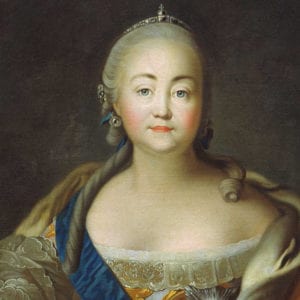
Elizabeth I of Russia was born in 1709 to Tsar Peter I, whom we know as Peter the Great, and his plebeian consort, Martha Skavronskaya, before their marriage. She inherited her father’s large frame and dark, striking looks, also his charisma and ability to influence people. She grew up in Saint Petersburg in the splendor of her father’s court, amidst the exhilarating progress and strife of Tsar Peter’s fast-paced, radical reforms of Russian society. (more…)
Marie Duplessis The Lady of the Camellias
Marie Duplessis (1824–1847) led a meteoric life. The girl who grew up to inspire The Lady of the Camellias by Alexandre Dumas and Verdi’s La Traviata began life as no lady, with no camellias and little else. We know that her original name was Alphonsine Plessis and that she was born into an impoverished, violent household in Normandy. (more…)
Delacroix’s portrait of George Sand and her most famous lover, Frederic Chopin
Delacroix’s portrait of George Sand and her most famous lover, Frederic Chopin, shows her sensual grace and the sensual tenderness between the two. Sand, born Aurore Dupin in 1804, helped put the free in freethinker. Daughter of an aristocrat and a proletarian Parisienne, Aurore was raised by her aristocratic grandmother, a well-meaning despot, at the family estate, Nohant. Aurore inherited two sets of irreconcilable rules, discarded both, and stepped into male privilege—and trousers. (more…)
One of the greatest Shady Ladies of art, Madame X
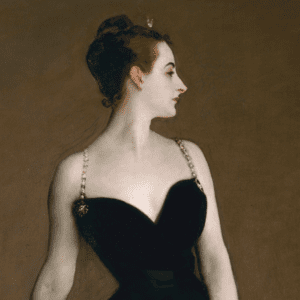
On every Shady Ladies tour of the Metropolitan Museum, at least one person tells me that John Singer Sargent’s Madame X is their favorite painting. And you can easily see why. It’s an arresting image, ambiguous and mysterious, and it creates for the viewer an image of a dramatic and complex woman. There are strange contradictions in it. For instance, the woman’s body is turned toward the viewer, but her face is turned—almost wrenched—to the side. Her skin is astonishingly white, her profile exaggeratedly aquiline, yet her hands are stubby and red, and her ear is inelegant and red as well—and very noticeable. And there are things that are hard to figure out: could her skin really be so extremely pale, or are her face, neck, shoulders, chest, and arms all thickly made up? (more…)
Shady Ladies Tour, an intro
People often ask how I went from doing gay secrets tours to shady ladies. How did a gay historian get interested in the history of female prostitution? First of all, a gay historian works on the history of sexuality, so the history of heterosexuality is not very far away from his topic, intellectually speaking. But it has much more to do with my tours of the Metropolitan Museum. (more…)