Tag: nyc

  • The Scandalous Life of Duchess of Berry

    The Scandalous Life of Duchess of Berry

    The scandalous Duchess of Berry was born as Marie Louise Élisabeth d’Orleans on 20 August 1695 at the Palace of Versailles to Philippe II, Duke of Orléans and Françoise-Marie de Bourbon, who was a legitimized daughter of Louis XIV of France.

    She was near death several times in her young life. At the age of six, she suffered a near-fatal illness, and her father himself nursed her day and night to save her. At the age of ten, she caught smallpox, and she was presumed dead for over six hours.

    At the age of 15, it was decided that she should marry Charles, Duke of Berry, who was the youngest son of the Grand Dauphin. The marriage took place on 6 July 1710 at the Palace of Versailles. The following year the new Duchess of Berry gave birth at the Palace of Fontainebleau to a baby girl. She lived for only two days. This death was blamed on the King who had made the Duchess travel with the court to the Palace of Fontainebleau. The barge the Duchesss was traveling in hit a pier and nearly sank. Apparently, the Duchess almost died.
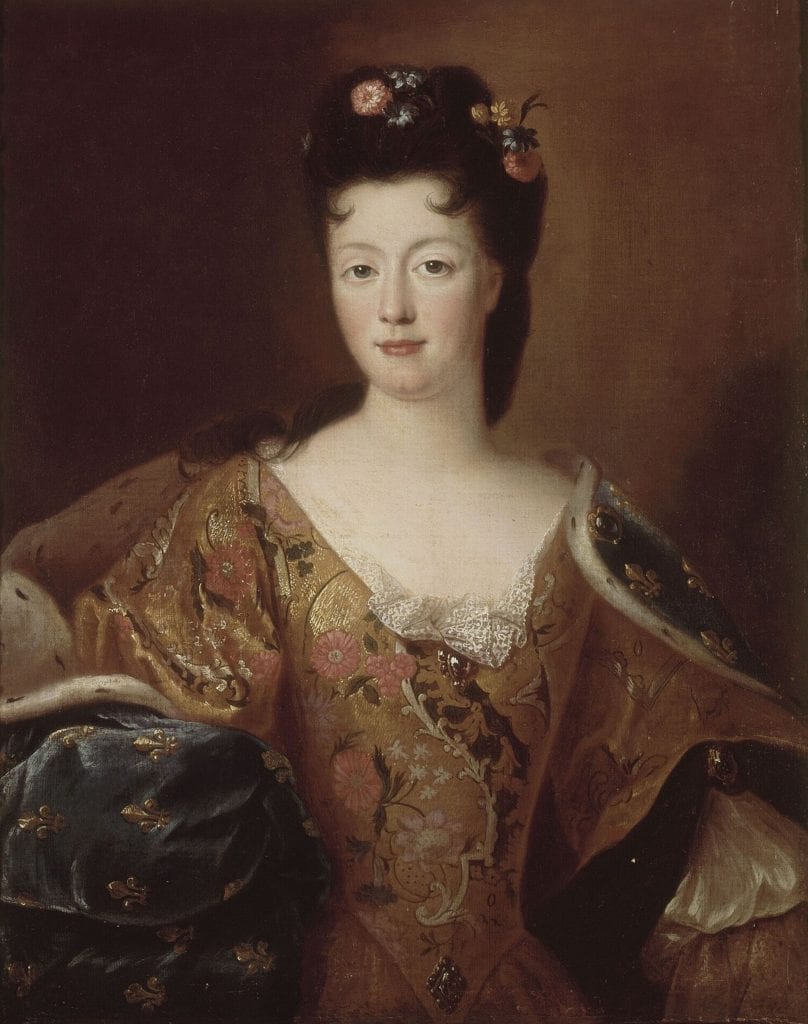
    On 26 March 1713, she gave birth to her second child, a son. He was given the title Duke of Alençon, but he died just three months later after an attack of convulsions.

    By the end of that year, rumours flew around that the Duke of Berry had taken a mistress and in turn, the Duchess also took a lover.

    When it became public knowledge, the Duke threatened to send her to a convent, and it’s even recorded that he kicked her in public.

    Apparently she intended to flee with her lover, but fortunately for her, her husband died suddenly on 5 May 1714 after a hunting accident. She was pregnant at the time, either by her husband or her lover. She gave birth on 16 June 1714 to a daughter who died the next day.

    By 1716 the Dowager Duchess was known for her balls. She claimed to be ill that year, officially with a bad cold. She gave birth to a girl, who only lived for three days.

    If she intended to keep this pregnancy a secret she had no luck, as it was soon public knowledge and ridiculed.


    Another pregnancy was rumored in 1717 as she was hiding in her Château de la Muette. The pregnancy was openly mocked:

    Very big with child
    The fruitful Berry
    Said in a humble posture
    Very sorry at heart :
    Lord, I will no longer have such lusty ways
    I only want Rions,
    Sometimes my dad,
    Here and there, my guards.
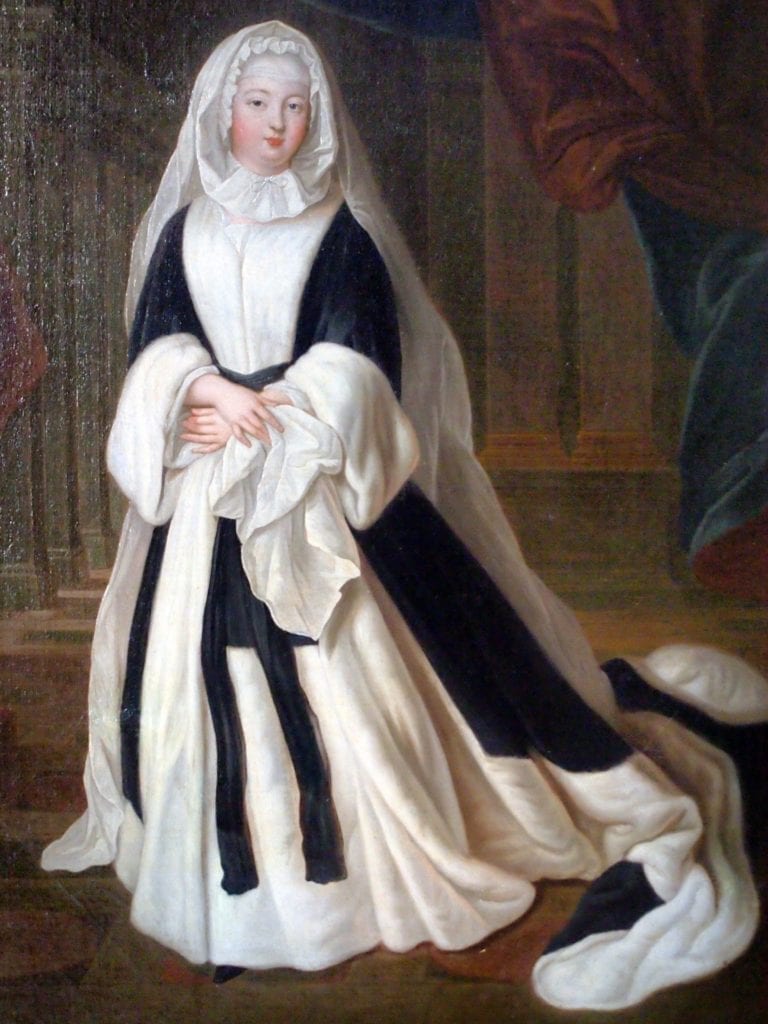
    Voltaire even wrote a play about the situation and the presence of the Duchess at the premiere added to its success. She was visibly pregnant, suggesting poor judgment! She gave birth to a baby girl in July 1717. This daughter appears to have survived to adulthood. According to one writer she became a nun.

    She gave birth to another baby girl on 2 April 1719 after an excruciating labor of four days. The child was stillborn. The father was rumored to be her lieutenant of the guards. She nearly died giving birth, and during the crisis, she was refused absolution and the sacraments unless she removed her lover from the palace. After the crisis was over the Duchess secretly married this lieutenant, Sicaire Antonin Armand Auguste Nicolas d’Aydie, perhaps hoping to lessen the scandal.

    Though her health had not fully recovered from the childbirth, she gave a reception in honor of her father. She apparently caught a chill that exacerbated her condition. She died on 21 July 1719, still only 23 years old.

    An autopsy revealed that the Duchess was again pregnant. She is buried in the Basilica of Saint-Denis.
    SUBSCRIBE TO OUR NEWSLETTER!

    source


  • Early Female Artists

    Early Female Artists

    For almost ten years, I’ve been researching and writing about American women artists working before 1945, with particular interest in resuscitating their careers. Everything about these women fascinates me–their struggle to become professionals in a world that doesn’t see women that way; the ways they negotiated their personal lives, loves, and family with their drive to succeed in the male-dominated art world; and of course, the artworks themselves.

    Encyclopedic museum collections like the Metropolitan Museum of Art include works by little-remembered women artists, and working with that phenomenal collection brought me to Shady Lady Tours. The Nasty Women tour opens the door to woman artists and women subjects from around the world and through time. These are women who didn’t take ‘no’ for an answer, who said ‘yes’ to opportunities. Smart. Forthright, Talented. Driven. Powerful in voice and in deed. What fun to introduce this prestigious sorority to tour goers.

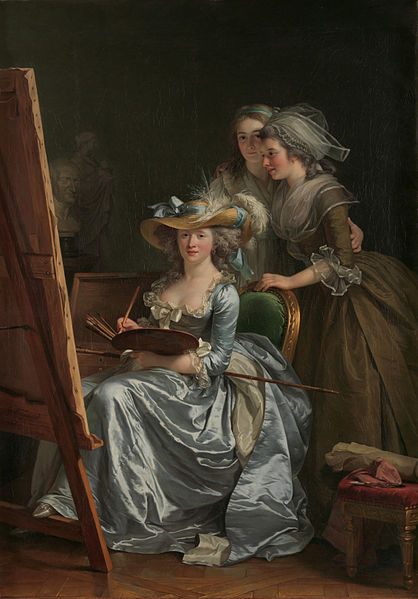
    Here are just two you’ll meet along the way. Look at how Adélaide Labille-Guiard gazes coolly and confidently at us, as we in turn take in her elegance and pride in her work. This woman is a force, and she uses her self-portrait to advocate for equality and fraternity for professional women artists in France, just as revolutionary forces are gathering for similar societal changes.

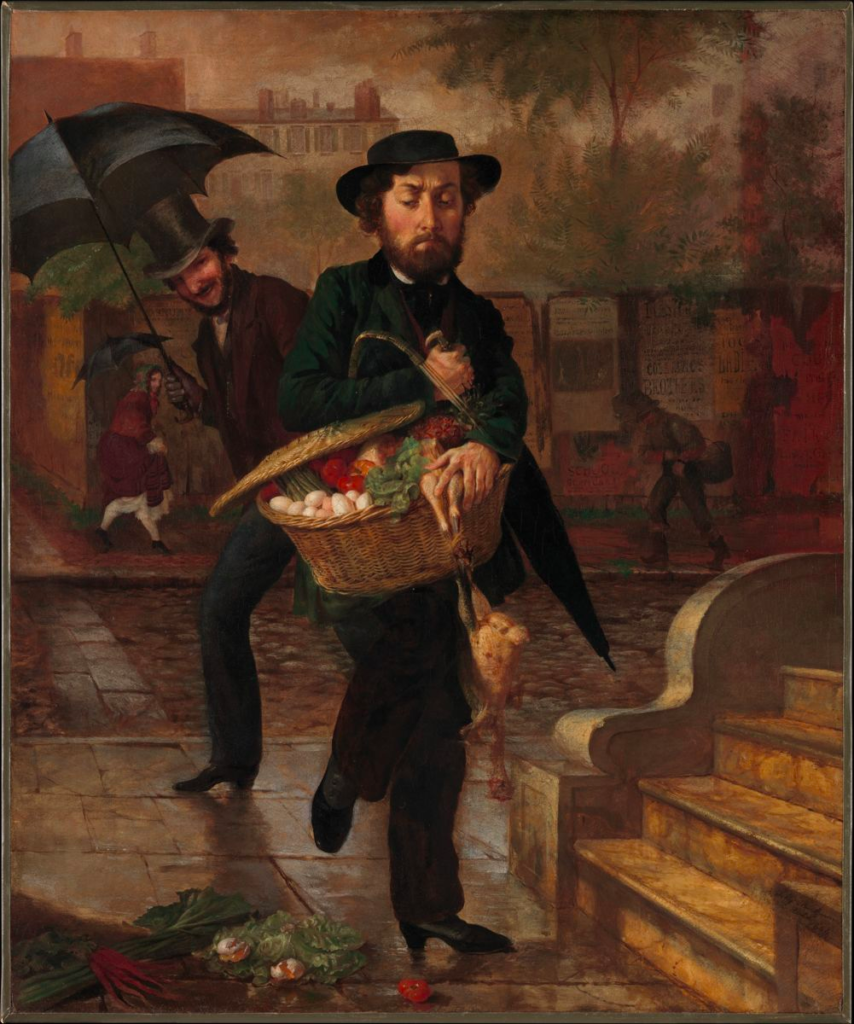
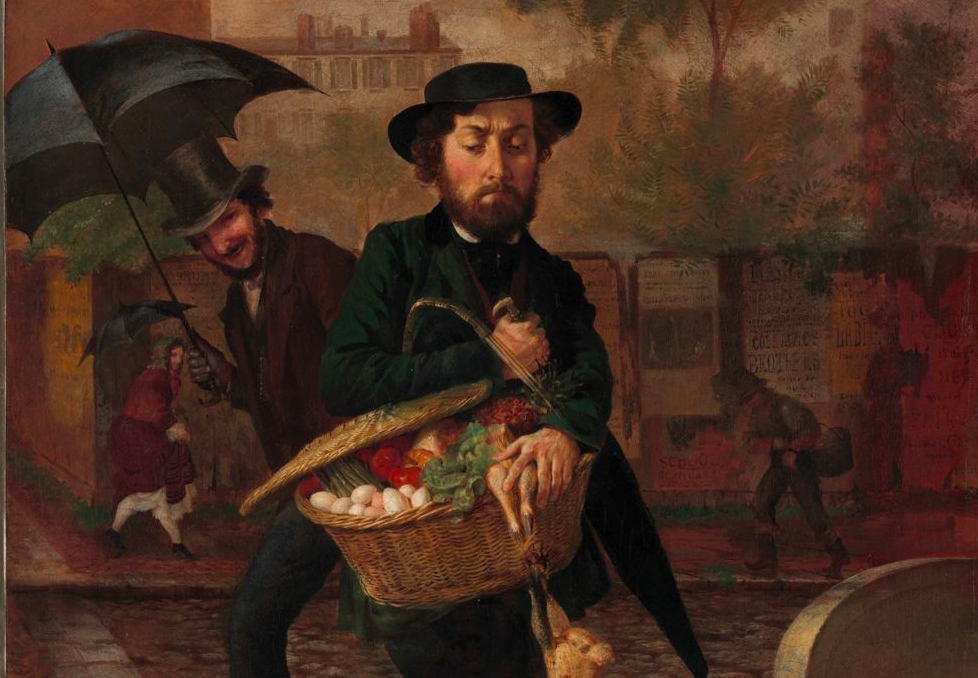
    Lilly Martin Spencer uses humor to make her point about gender equality. But where is she? Not in the painting, but making it, from the confines of her middle class, New York City home. Husband Benjamin, unable to support their growing family financially, instead muddles through the domestic sphere task of shopping with clumsy inelegance. Spencer has a thing or two to say about women’s roles, as wives, as partners, as painters.

    Come join me on a Nasty Women tour, to meet these artists and more powerhouse women from the Met’s exceptional collection. See you there!

  • Painter Mary Ann Alabaster

    Painter Mary Ann Alabaster

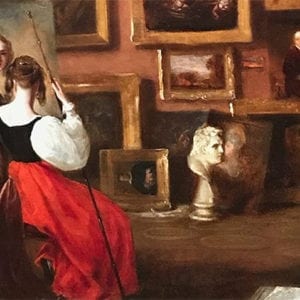
    One of the most important traditions among women painters is the self-portrait in which the artist claims her status as an artist. This is a 19th century English example, by the painter Mary Ann Alabaster, who shows you herself painting a portrait of herself (a self-portrait within a self-portrait) surrounded by her works in different genres. (more…)

  • A transitional moment in the status of women in the arts

    A transitional moment in the status of women in the arts

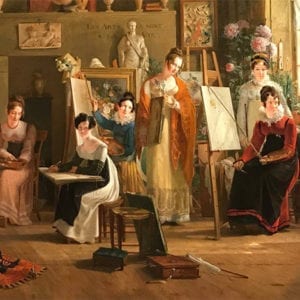
    This picture shows us a transitional moment in the status of women in the arts. We see a group of women studying in an artist’s studio, which is of course relatively modern, as there were no studios where groups of women studied before the mid-18th century, even in Paris. (more…)

  • The feminist concept of the “male gaze”

    The feminist concept of the “male gaze”

    The feminist concept of the “male gaze” is useful in art criticism. The concept originally comes from film studies, where it is used to discuss the fact that men traditionally controlled the camera, of which women were an object. Men certainly also controlled the brush through most of the history of Western painting, and the women in paintings generally acknowledge this. As the art historian John Berger said, women in painting don’t usually look out at the viewer: they aren’t considering the viewer, but considering how the viewer sees them. They have an inward gaze, rather than an outward gaze. But painters can also violate this “rule” (more a tendency really) to depict a woman who has power or confidence.

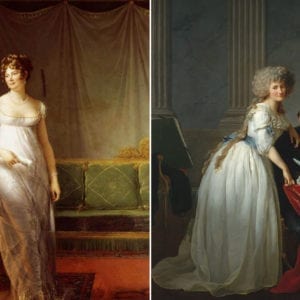
    Two paintings that are diagonally across from each other at the Metropolitan Museum make this clear. On the one hand, we have Gérard’s portrait of the Princess of Talleyrand, a courtesan who became Talleyrand’s mistress and then his wife. She was considered very beautiful in her time and is dressed in the latest Empire fashions, and she looks down and to the side in her portrait. Her gaze avoids the viewer’s: she is absorbed in her own thoughts, or her own coquetry, it’s unclear which. Across the gallery is David’s double portrait of the great scientist Lavoisier and his wife, Marie-Anne Paulze. Here the male inside the painting definitely does not control the gaze: he looks up at his wife questioningly, while she does not return his gaze (though she puts her hand on his shoulder with a gesture of intimacy unusual in painting). Instead she turns to look out directly and confidently (though not aggressively) at the viewer: it is she who communicates with the world on behalf of this couple. And in fact this portrays something real about this couple. Paulze had many public-facing characteristics that Lavoisier lacked: she spoke many languages and could inform Lavoisier about the scientific literature of the whole of Europe. And she was also his lab illustrator, explaining his/their experiments to the world through the visual arts. Look at the women you see in the art museum the next time you go. Do they look out at the viewer, or not, and why?

    https://www.facebook.com/events/724999504353889

  • Shady Ladies Featured In O, The Oprah Magazine!

    Shady Ladies Featured In O, The Oprah Magazine!

    We are so grateful for being included on the ‘Gratitude Meter5 Things We’re Smiling About in this month’s issue of O, The Oprah Magazine! When it comes to Shady Ladies Tours, Oprah exemplifies the kind of ambitious, glass ceiling breaking woman that our tours are all about! (more…)

  • Meet Lady Emma Hamilton A Woman Of Great Beauty

    Meet Lady Emma Hamilton A Woman Of Great Beauty

    Emma Hamilton The way from social obscurity to social stardom has traditionally been even narrower than the strait gate and narrow way to salvation. However, iconic looks, talent, intelligence, and a heaping helping of golden luck have been known to buy one’s way out and up.

    Emma Hamilton was born in 1765, among the working poor. Ordinarily, the nearest such a girl would have come to the aristocracy would have been cleaning up after them. She was working as a servant in London at twelve; she moved on to a brothel, then an establishment known as the Temple of Health and Hymen. Her first protector was one Sir Harry Featherstonebaugh. Supposedly she helped entertain his companions by dancing naked on his table. She attracted the notice of the Hon. Charles Greville, nephew of Sir William Hamilton. Charmed, Greville commissioned George Romney to paint portraits of her and make the public aware of the iconic face. Romney became quite obsessed with her and produced numerous portraits that convey both the heat of his interest and his subject’s charisma. At nineteen she was also painted by Sir Joshua Reynolds in a characteristic pose: a mischievous, meditative look over her shoulder, right hand delicately fingering her cheek. (more…)

  • Yoshiwara, the ‘pleasure quarter’ of the city of Edo

    Yoshiwara, the ‘pleasure quarter’ of the city of Edo

    A couple of weeks ago I took a meander around the Met to see what new stuff was hanging–and what did I find? Lots of new courtesans! In particular, there is now a whole gallery of Japanese paintings of beautiful women–including a number of courtesans, such as this woman in a scroll from the 1780s by Isoda Koryusai. This painting seems to show the main street of the Yoshiwara, the ‘pleasure quarter’ of the city of Edo (modern Tokyo). A courtesan is promenading with her two assistants (or perhaps apprentices). She is the height of fashion, or perhaps overdone—as was apparently typical of these women—wearing multiple layers of elaborate kimonos, and the huge clogs which were typical of courtesans–clogs which made it impossible to walk naturally (a custom that reminds me of Chinese foot-binding). (more…)

  • Sammu Ramat Empress Regnant Assyria

    Sammu Ramat Empress Regnant Assyria

    In Rossini’s opera about her, Queen Semiramide of Assyria walks onstage right into a problem: The aristocratic politician who helped her poison her husband and usurp his throne wants her to fulfill her end of the bargain and nominate him to rule the nation. Payment due! (more…)

  • Spanish Opera Singer Maria Malibran

    Spanish Opera Singer Maria Malibran

    Maria Malibran entered the world in 1808 with an uncommonly interesting backstory and set of genes. Her father, the famous tenor Manuel Garcia, was probably half-Romany; her Spanish mother was a more minor opera singer. Garcia was a spectacular singer, a brilliant teacher, and a manic brute. Determined to make his daughter into one of the planet’s most brilliant vocalists, he battered and terrorized her regularly in service to this aim. Did she start life with a miraculous voice? She had one by the time she made her debut at a London concert at 16, just old enough to be a sophomore in a postmodern American high school. By that time, she already had a range from E below middle C to high C. At 17, she made her operatic debut as Rosina in The Barber of Seville to great acclaim. (more…)

Check Out Our Upcoming

ZOOM TOURS

BOOK NOW