London’s National Portrait Gallery has a great collection of portraits of famous and important people from British history. If you ask the general public what that means, they would tell you it’s a great place to see images of kings, queens, prime ministers, and other great people (mostly men). But actually, the National Portrait Gallery’s collection is much more fun than people realize. It contains a lot of portraits of people with really entertaining stories, and these stories often revolve around the one thing that can make historical people seem really relatable: love and sex. And many of the most interesting stories are about *women*.
Bold and sexy women must always have existed everywhere, but in history they seem to be a French specialty. There are a number of places where you can learn about them in Paris. The Louvre and Orsay museums are great, for instance, or the royal palace at Versailles. But if you are interested in the colorful sides of Paris women’s history, don’t miss Père Lachaise Cemetery!
Père Lachaise, founded under Napoleon in 1804, was Paris’s first non-sectarian cemetery. It was also the first garden cemetery, a 19th century trend that brought us London’s so-called Magnificent Seven cemeteries, New
Père Lachaise Cemetery
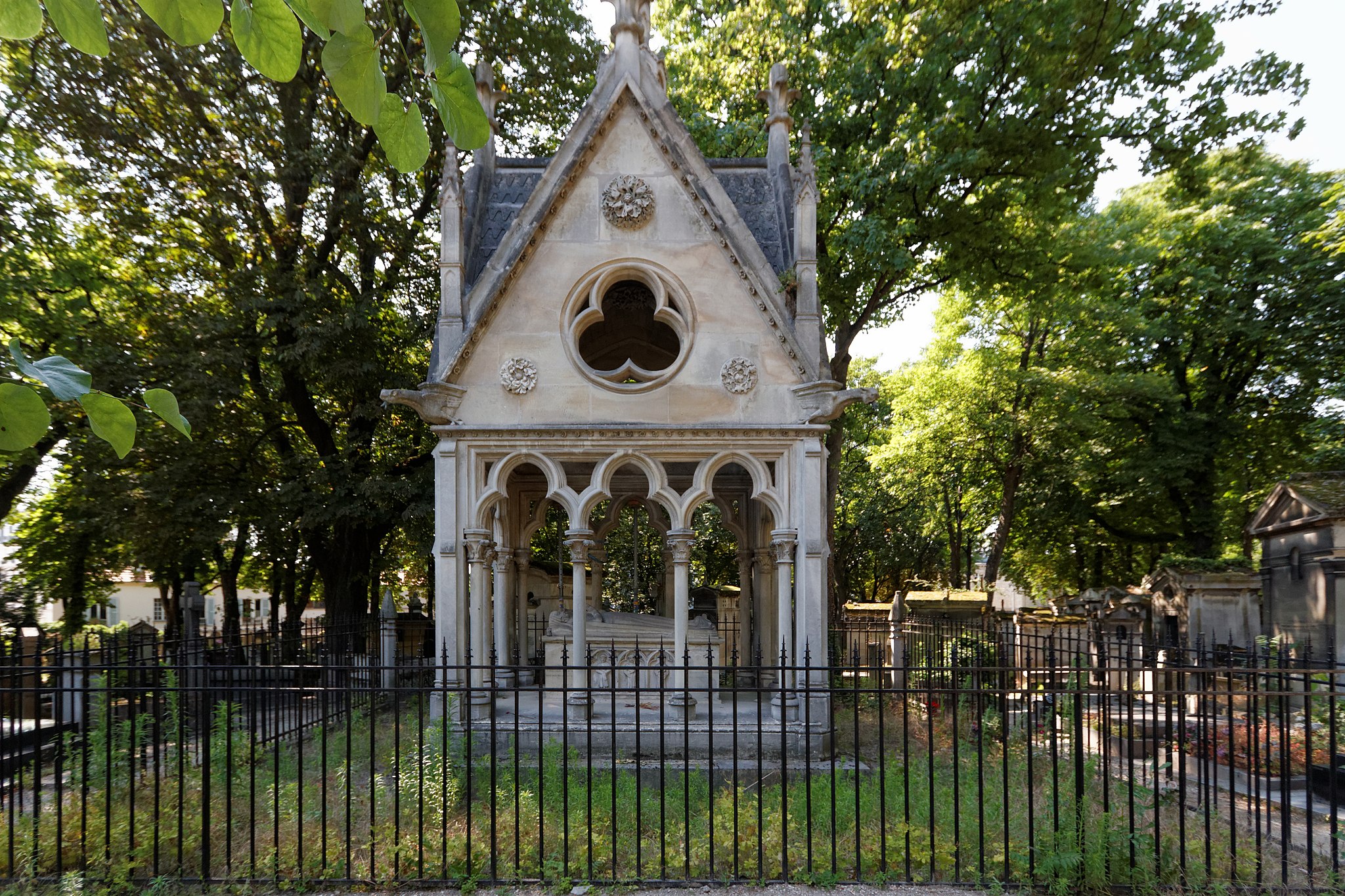
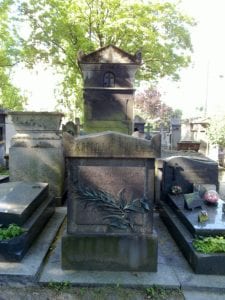
York’s Green-wood, Boston’s Mount Auburn, and so on. These cemeteries were intended as parks, where the public could stroll and even picnic. And one of the attractions (aside from groves, ponds, etc) was meant to be the magnificent tombs of well-known people. Indeed, the founders of Père Lachaise jump-started this aspect by transferring some famous tombs there, including the one you see above. Thus is the joint tomb of the iconic romantic couple of the Middle Ages, theologian Abélard and his abbess wife Héloïse.
And they were certainly successful in attracting the tombs of the prominent—including many prominent women. There are certainly famous men in the cemetery, such as (to start with composers) Chopin, Rossini, and Bizet. And the two most visited tombs are those of English-world celebs Oscar Wilde and Jim Morrison. Yet there are many fascinating women buried here as well. A short list would be long but would have to include: Sarah Bernhardt, Isadora Duncan, Gertrude Stein and Alice B Toklas, Colette, Maris Callas, and Edith Piaf. These are the kind of bold and sexy women that makes Paris women’s history so special and intriguing.
Here are three of my favorite tombs in Père Lachaise. Two are of women, and one is (as I will explain) important to Parisian women.
The racy writer
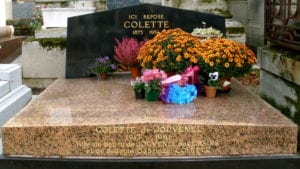
I’ll start with one from my list above: the tomb of Colette, which is right near the main
Colette’s tomb
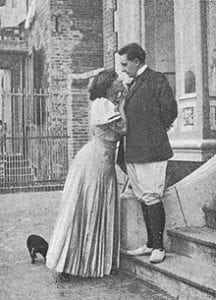
entrance to the cemetery. Colette was an astonishing person. She is probably the most famous French woman writer today. Her four early Claudine novels are very popular in France. And her last book, Gigi, is well-known around the world—mainly, no doubt, because of the movie, starring Audrey Hepburn—whom Colette herself discovered. She was also a racy person. After she had left her first husband (who discovered her gift for writing but kept the copyrights to her first books for himself) she created a scandal by carrying on an affair with a cross-dressing aristocrat called Mathilde de Morny, and generally known at the time as Max or uncle Max. The scandal reached its peak when Colette and Max
Colette and Max
kissed on stage at the Moulin Rouge—a pretty bold gesture for 1907! Colette kept most of her raciness for her writing, however, in which her biggest themes are lesbianism and courtesans—the high class sex workers who were so important in Belle Epoque Paris’s life and of whom Colette’s Gigi is the most famous example.
The cross-dressing painter
A thruple in death: Ducas, Bonheur, Klumpke
Next is another tomb of a bold and racy woman, the painter Rosa Bonheur. Bonheur is not famous today, but before the Impressionists began the turn toward abstraction that typifies modern art, she was a big star of the art world. An example in an American museum is the vast hyperrealistic The Horse Fair that fills a wall at the Metropolitan Museum.
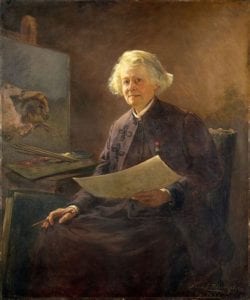
Bonheur probably interests modern viewers more as a personality than as an artist, though. She was one of those artistic 19th century women who lived her life in households consisting of two women—what today historians call ‘Boston marriages.’ It is impossible for us to know what went on in private, but one tends to assume that the women in these ‘marriages’ were mostly what today we would call lesbians. But Bonheur was not only probably a lesbian, she was also what we would call gender-queer. She was strikingly non-feminine and often dressed in men’s clothing. She lived in two Boston marriages: the first with a woman called Nathalie Ducas, the second (after Ducas’s death) with an American painter called Anna Klumpke.
Bonheur by Klumpke
I am giving you two pictures. One is a striking portrait of the elderly Bonheur by Klumpke, the other the Ducas family tomb, where not only Nathalie is buried, but also Bonheur and Klumpke both (as you can see from the plaques on the front).
The fertility cult
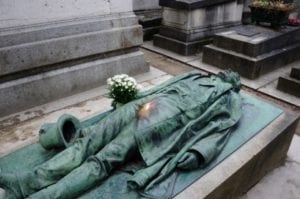
Finally, let me show you one of the sights every Parisian knows in the cemetery: the tomb of Victor Noir. Noir a young left-wing journalist who was shot by Prince Pierre Bonaparte, and his tomb long served As the center of many left-wing rallies. You might think you’re seeing things, but no, that really is a realistic death erection in his trousers,
Victor Noir’s tomb
and yes, it is rubbed clean of verdigris. If you look carefully, you can see that his lips are also clean. That is because Victor, with his erection, serves as a fertility cult place-of-worship for Parisian women who want to pray to find a boyfriend, get pregnant etc. The tradition is that you kiss his lips, leave flowers in his hand (as you can see in the photo) or hat and rub his erection. I have heard from some gay friends that they pray to Victor Noir as well!
So if you want to know about Paris women’s history—the history of bold and sexy women that really is one of the things that makes Paris Paris—don’t only visit the museums and Versailles. Take a stroll around Père Lachaise as well! Or, if you can’t go to Paris (because none of us can go anywhere right now!) take Shady Ladies Tours’ Père Lachaise tour on Zoom the next time we offer it.
Imperia Cognati (also called Imperia La Divina, meaning Imperia The Divine, or The Queen of Courtesans, 3 August 1486 – 15 August 1512), was a Roman courtesan. She has been considered the first celebrity of the class of courtesans, which was created in Rome in the late 15th century. (more…)
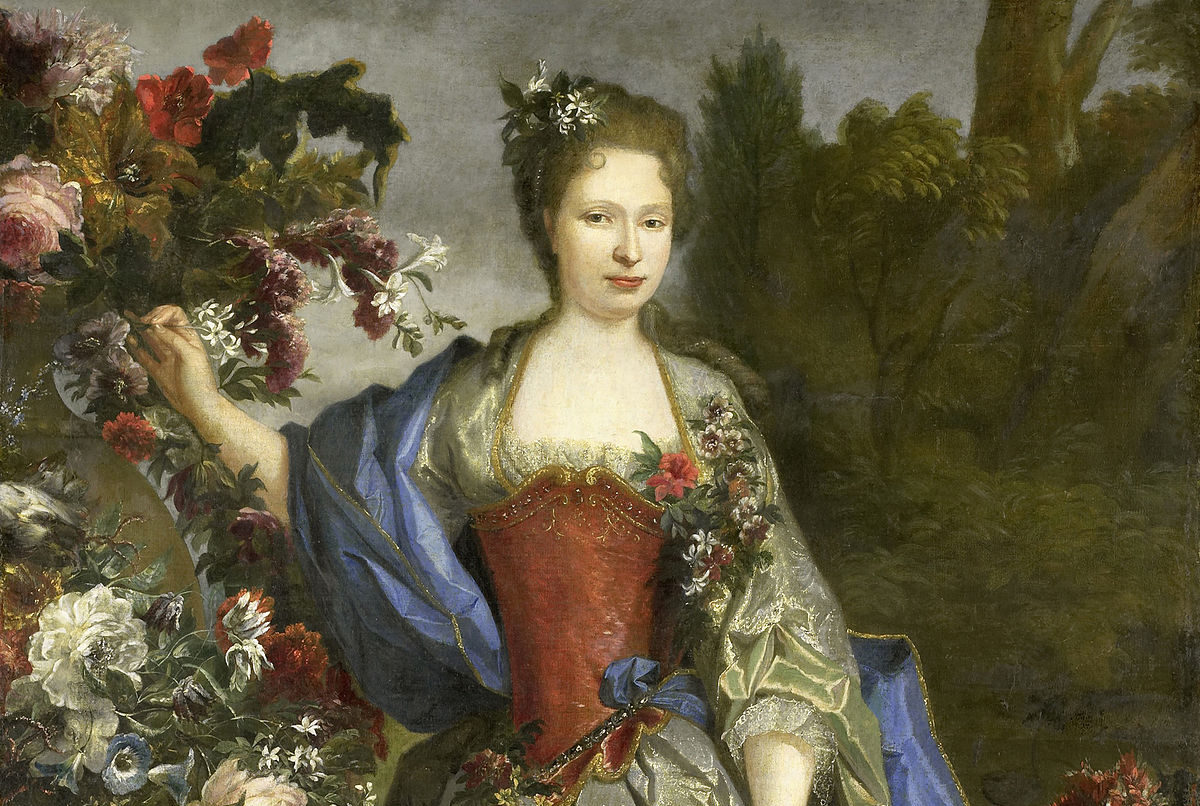
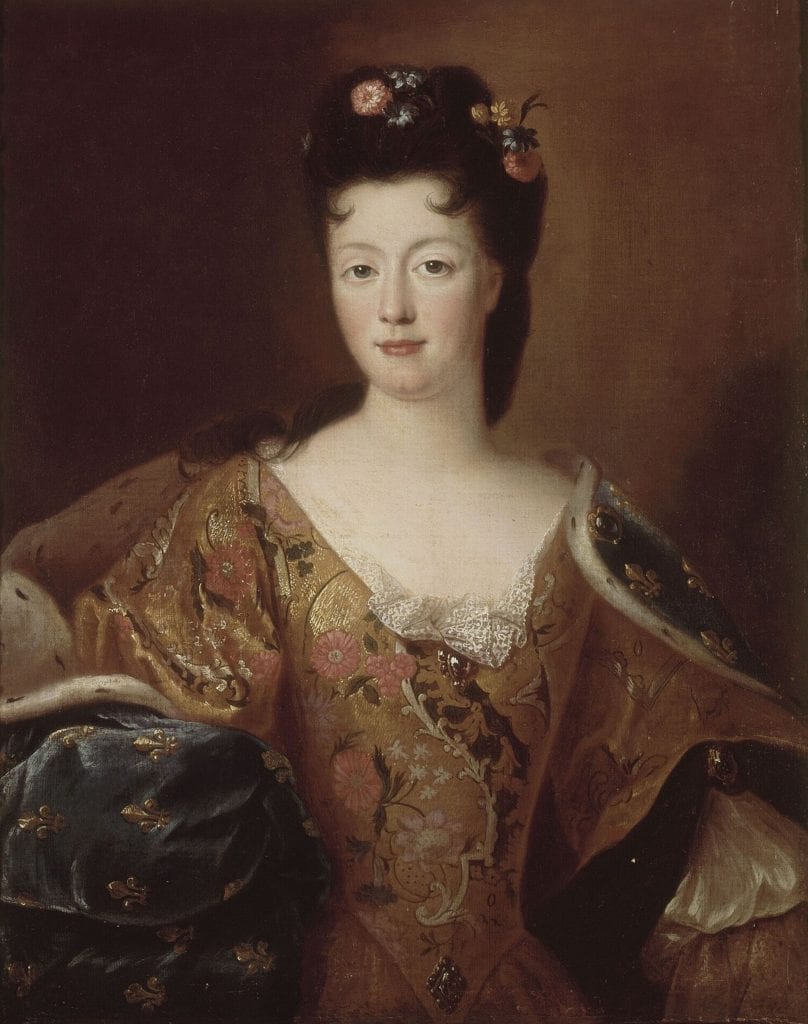
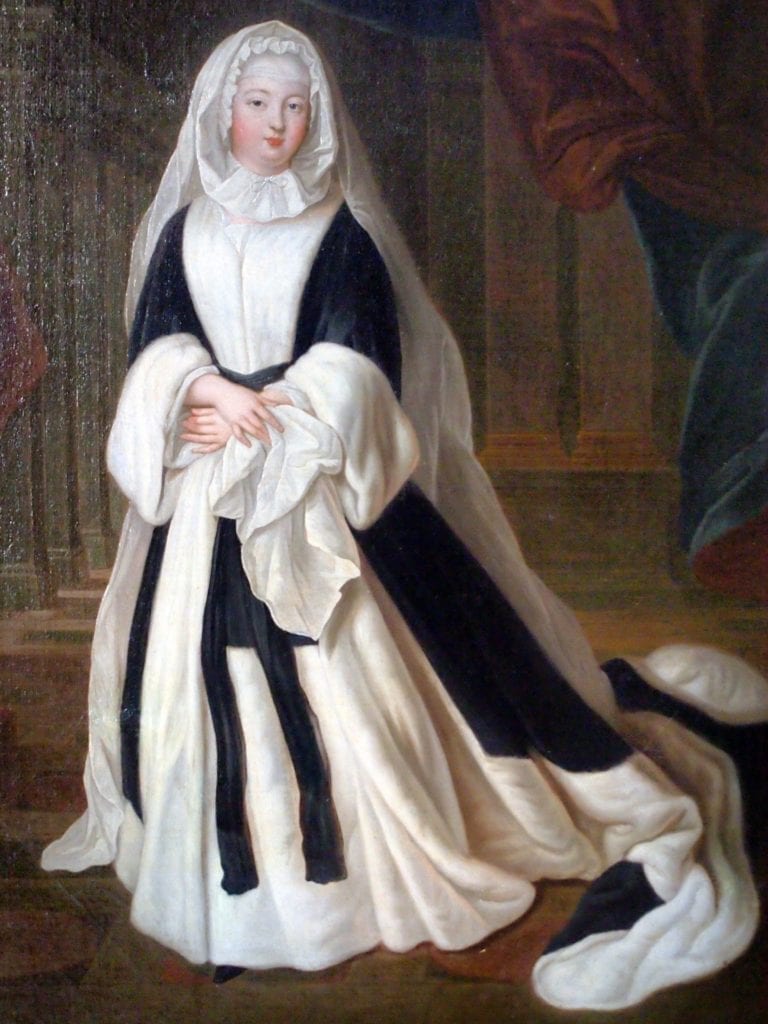
The scandalous Duchess of Berry was born as Marie Louise Élisabeth d’Orleans on 20 August 1695 at the Palace of Versailles to Philippe II, Duke of Orléans and Françoise-Marie de Bourbon, who was a legitimized daughter of Louis XIV of France.
She was near death several times in her young life. At the age of six, she suffered a near-fatal illness, and her father himself nursed her day and night to save her. At the age of ten, she caught smallpox, and she was presumed dead for over six hours.
At the age of 15, it was decided that she should marry Charles, Duke of Berry, who was the youngest son of the Grand Dauphin. The marriage took place on 6 July 1710 at the Palace of Versailles. The following year the new Duchess of Berry gave birth at the Palace of Fontainebleau to a baby girl. She lived for only two days. This death was blamed on the King who had made the Duchess travel with the court to the Palace of Fontainebleau. The barge the Duchesss was traveling in hit a pier and nearly sank. Apparently, the Duchess almost died.
On 26 March 1713, she gave birth to her second child, a son. He was given the title Duke of Alençon, but he died just three months later after an attack of convulsions.
By the end of that year, rumours flew around that the Duke of Berry had taken a mistress and in turn, the Duchess also took a lover.
When it became public knowledge, the Duke threatened to send her to a convent, and it’s even recorded that he kicked her in public.
Apparently she intended to flee with her lover, but fortunately for her, her husband died suddenly on 5 May 1714 after a hunting accident. She was pregnant at the time, either by her husband or her lover. She gave birth on 16 June 1714 to a daughter who died the next day.
By 1716 the Dowager Duchess was known for her balls. She claimed to be ill that year, officially with a bad cold. She gave birth to a girl, who only lived for three days.
If she intended to keep this pregnancy a secret she had no luck, as it was soon public knowledge and ridiculed.
Another pregnancy was rumored in 1717 as she was hiding in her Château de la Muette. The pregnancy was openly mocked:
Very big with child The fruitful Berry Said in a humble posture Very sorry at heart : Lord, I will no longer have such lusty ways I only want Rions, Sometimes my dad, Here and there, my guards.
Voltaire even wrote a play about the situation and the presence of the Duchess at the premiere added to its success. She was visibly pregnant, suggesting poor judgment! She gave birth to a baby girl in July 1717. This daughter appears to have survived to adulthood. According to one writer she became a nun.
She gave birth to another baby girl on 2 April 1719 after an excruciating labor of four days. The child was stillborn. The father was rumored to be her lieutenant of the guards. She nearly died giving birth, and during the crisis, she was refused absolution and the sacraments unless she removed her lover from the palace. After the crisis was over the Duchess secretly married this lieutenant, Sicaire Antonin Armand Auguste Nicolas d’Aydie, perhaps hoping to lessen the scandal.
Though her health had not fully recovered from the childbirth, she gave a reception in honor of her father. She apparently caught a chill that exacerbated her condition. She died on 21 July 1719, still only 23 years old.
An autopsy revealed that the Duchess was again pregnant. She is buried in the Basilica of Saint-Denis.
One of the most important traditions among women painters is the self-portrait in which the artist claims her status as an artist. This is a 19th century English example, by the painter Mary Ann Alabaster, who shows you herself painting a portrait of herself (a self-portrait within a self-portrait) surrounded by her works in different genres. (more…)
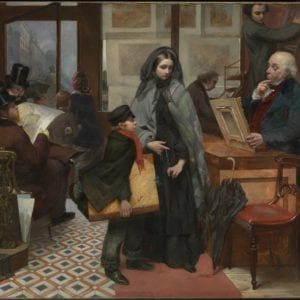
Emily Mary Osborn was one of the most important artists associated with the campaign for women’s rights in the nineteenth century. The daughter of a clergyman, she was brought up in Kent and Essex until 1842 when the family moved back to London. It was here that she trained as an artist at Dickinson’s academy in Maddox Street and then at Leigh’s in Newman Street. During the 1850s Osborn established a reputation as a genre painter specialising in figurative subjects of ‘unpretending character’ – the most significant of which were pictures of modern women in pathetic situations, similar to works by Richard Redgrave and Rebecca Solomon. Home Thoughts, which was painted in 1856 and exhibited at the Royal Academy that same year, was followed by her most famous work Nameless and Friendless in 1857. A full-scale, squared-up preparatory design for the latter exists in the Ashmolean Museum in Oxford and a smaller version in oil in York Art Gallery. (more…)
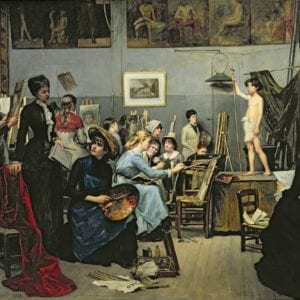
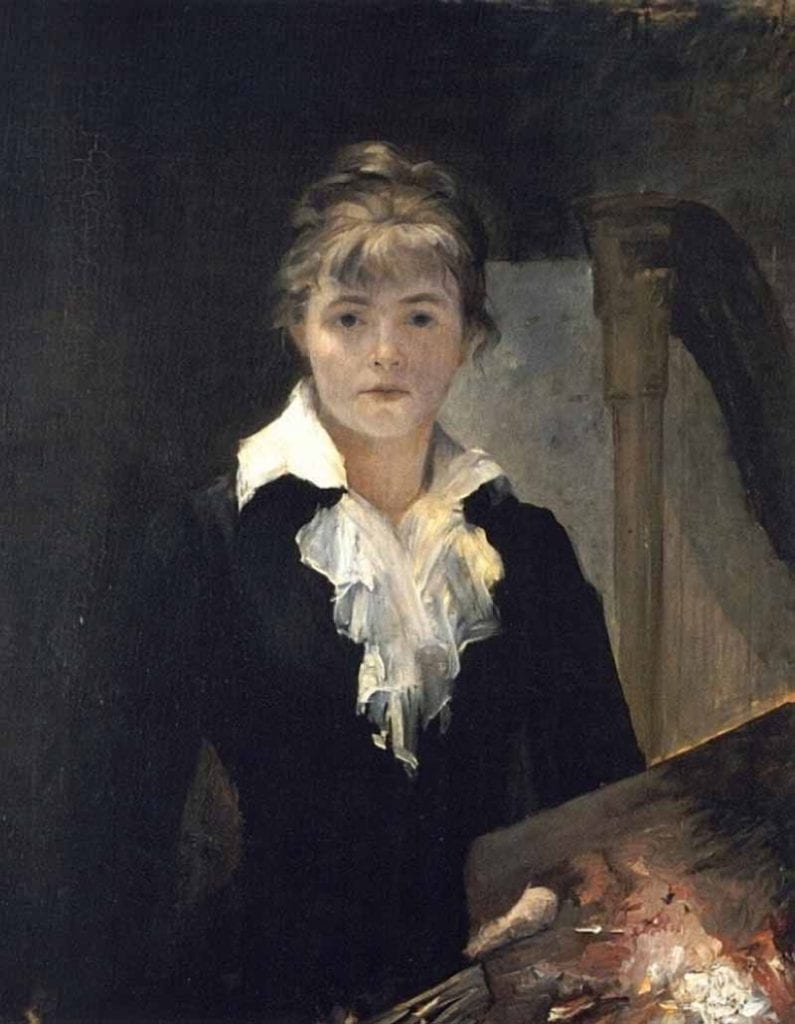
The self-portrait is probably the most interesting tradition among women artists. Often women artists portray themselves as artists, or rather claim their status as an artist though self-portraiture; paintings of other women artists painting are a related tradition, involving a kind of vicarious self-portraiture. This painting gives us both sides of the tradition: the artist, Marie Baltshirtseff, is in the foreground, but we also see a whole studio of women art students.
It also shows us a key space in the history of women in the arts: the Académie Julian, one of the only places in 19th century Paris that gave rigorous training to women artists and consequently the alma mater of many women painters, such as Cecelia Beaux (but also non-French artists in general, e.g. John Singer Sargent). Though the Académie Julian allowed women to study nudes (at least semi-nudes), it was considered too scandalous for male and female students to paint nudes together; as a result, we see an all-female class in this scene, painting a semi-clothed boy posing as St. John the Baptist. Interested in the history women artists? Come on the Nasty Women tour of the Metropolitan!