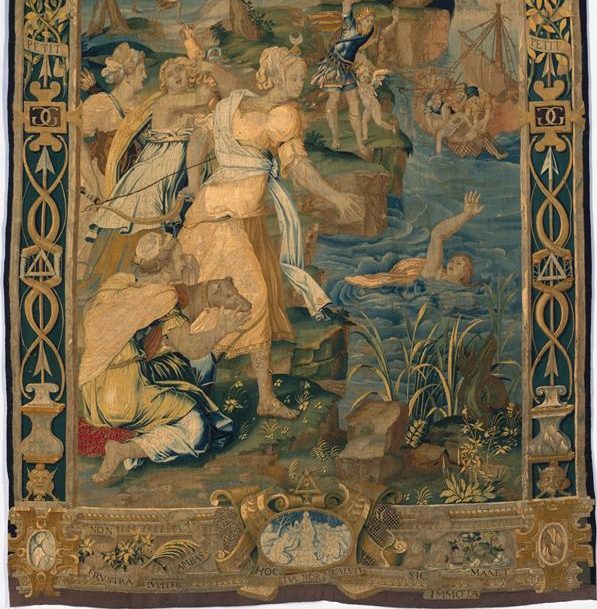
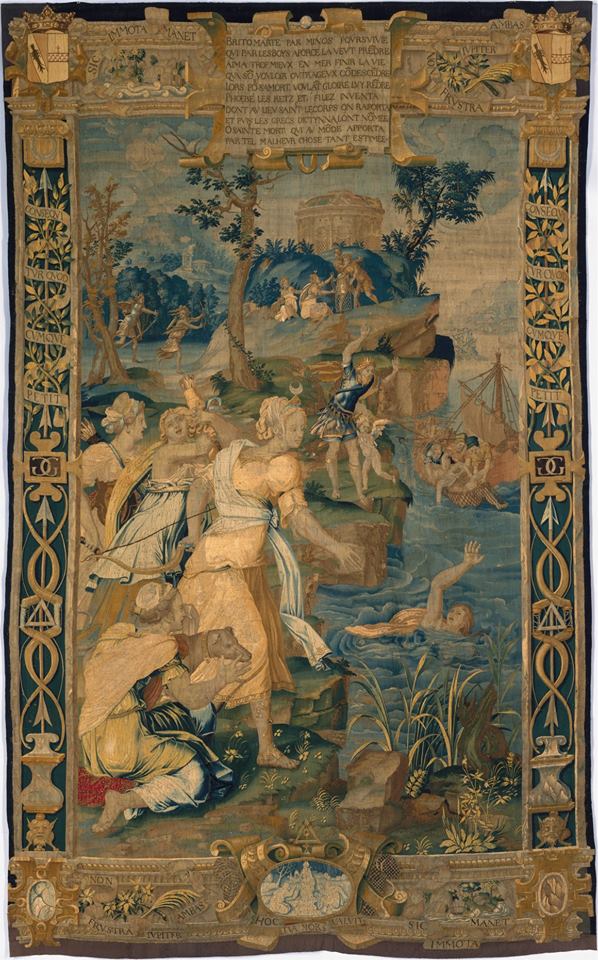
Diane de Poitiers, represented on this wall hanging as the goddess Diana, was so powerful in France when she was the mistress of King Henri II that they often signed his correspondence with one word: HENRIDIANE. Find out more about powerful women in history on the Nasty Women tour!
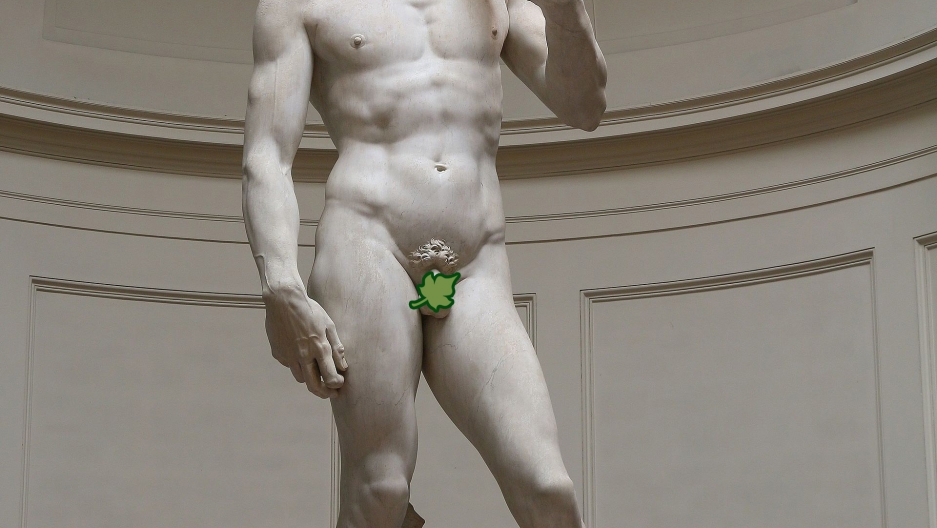
Why is contemporary culture obsessed with how well-endowed men are, and yet in classical art men are so small? Kurt Andersen unravels the mystery with a classics scholar, Andrew Lear.
For almost ten years, I’ve been researching and writing about American women artists working before 1945, with particular interest in resuscitating their careers. Everything about these women fascinates me–their struggle to become professionals in a world that doesn’t see women that way; the ways they negotiated their personal lives, loves, and family with their drive to succeed in the male-dominated art world; and of course, the artworks themselves.
Encyclopedic museum collections like the Metropolitan Museum of Art include works by little-remembered women artists, and working with that phenomenal collection brought me to Shady Lady Tours. The Nasty Women tour opens the door to woman artists and women subjects from around the world and through time. These are women who didn’t take ‘no’ for an answer, who said ‘yes’ to opportunities. Smart. Forthright, Talented. Driven. Powerful in voice and in deed. What fun to introduce this prestigious sorority to tour goers.
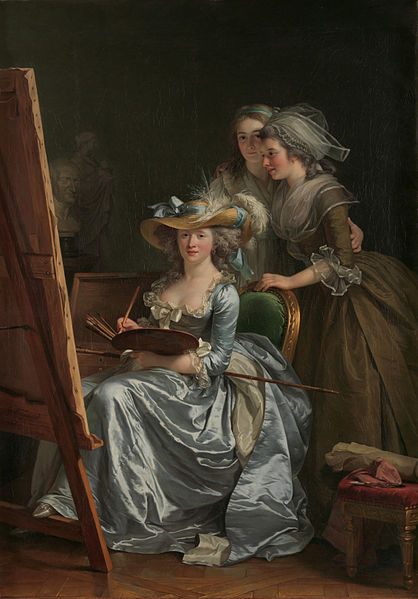
Here are just two you’ll meet along the way. Look at how Adélaide Labille-Guiard gazes coolly and confidently at us, as we in turn take in her elegance and pride in her work. This woman is a force, and she uses her self-portrait to advocate for equality and fraternity for professional women artists in France, just as revolutionary forces are gathering for similar societal changes.
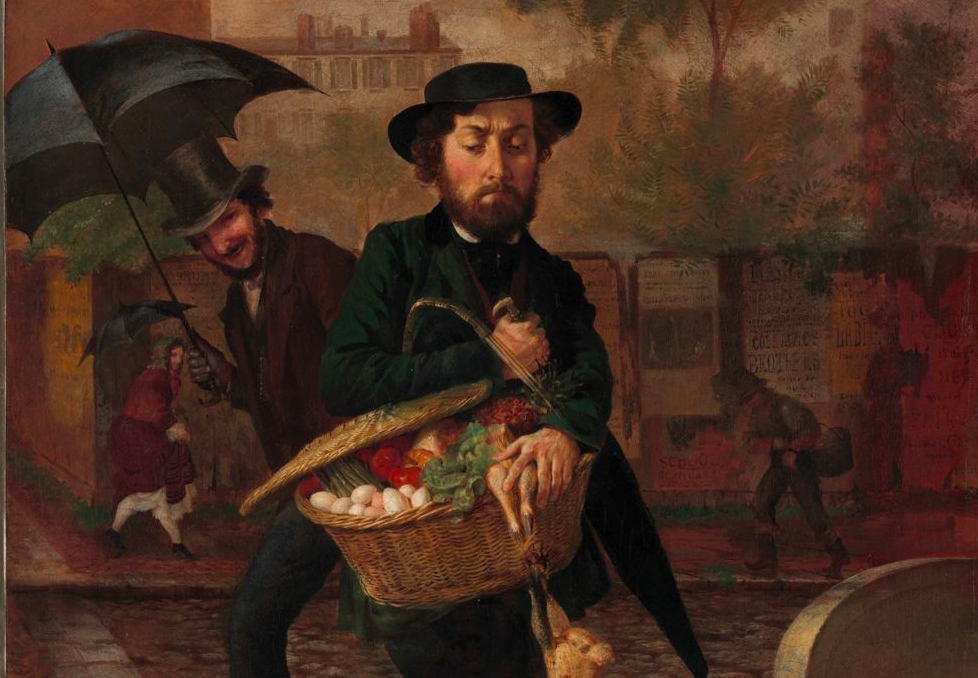
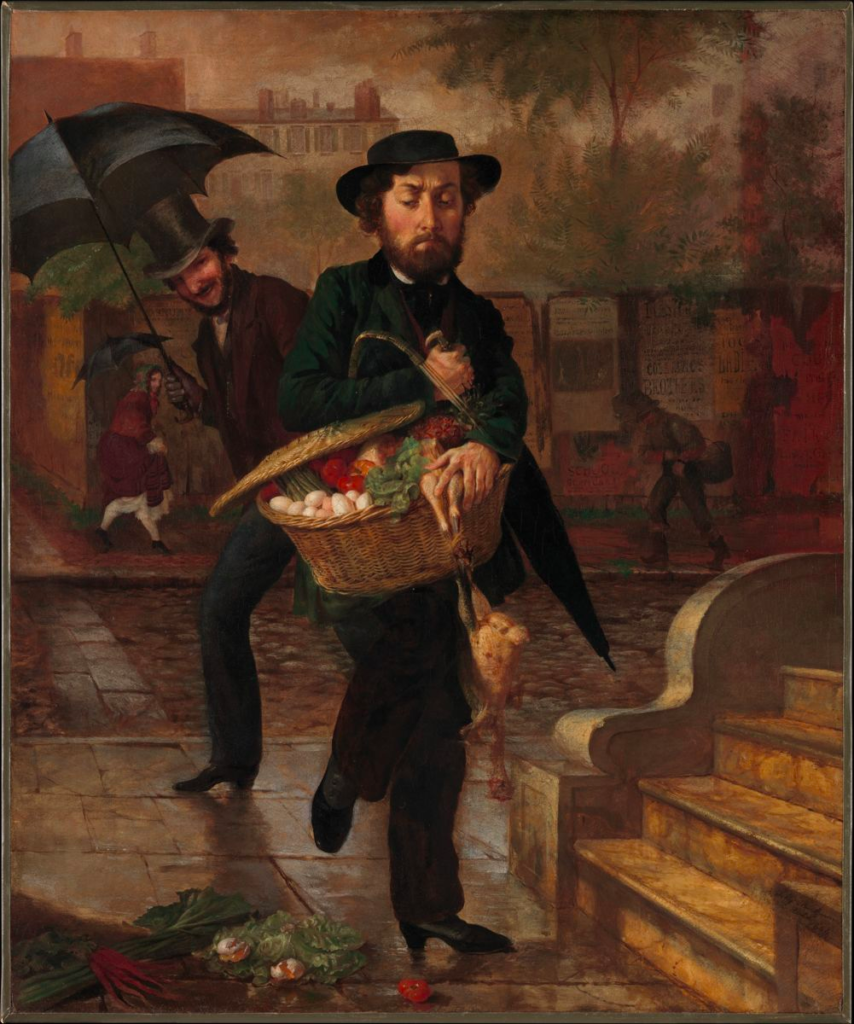
Lilly Martin Spencer uses humor to make her point about gender equality. But where is she? Not in the painting, but making it, from the confines of her middle class, New York City home. Husband Benjamin, unable to support their growing family financially, instead muddles through the domestic sphere task of shopping with clumsy inelegance. Spencer has a thing or two to say about women’s roles, as wives, as partners, as painters.
Come join me on a Nasty Women tour, to meet these artists and more powerhouse women from the Met’s exceptional collection. See you there!
One of the most important traditions among women painters is the self-portrait in which the artist claims her status as an artist. This is a 19th century English example, by the painter Mary Ann Alabaster, who shows you herself painting a portrait of herself (a self-portrait within a self-portrait) surrounded by her works in different genres. (more…)
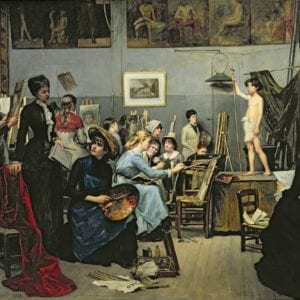
This picture shows us a transitional moment in the status of women in the arts. We see a group of women studying in an artist’s studio, which is of course relatively modern, as there were no studios where groups of women studied before the mid-18th century, even in Paris. (more…)
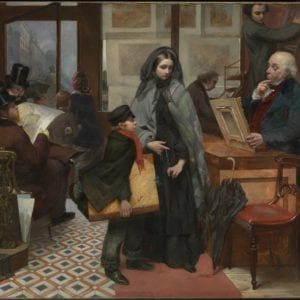
Emily Mary Osborn was one of the most important artists associated with the campaign for women’s rights in the nineteenth century. The daughter of a clergyman, she was brought up in Kent and Essex until 1842 when the family moved back to London. It was here that she trained as an artist at Dickinson’s academy in Maddox Street and then at Leigh’s in Newman Street. During the 1850s Osborn established a reputation as a genre painter specialising in figurative subjects of ‘unpretending character’ – the most significant of which were pictures of modern women in pathetic situations, similar to works by Richard Redgrave and Rebecca Solomon. Home Thoughts, which was painted in 1856 and exhibited at the Royal Academy that same year, was followed by her most famous work Nameless and Friendless in 1857. A full-scale, squared-up preparatory design for the latter exists in the Ashmolean Museum in Oxford and a smaller version in oil in York Art Gallery. (more…)
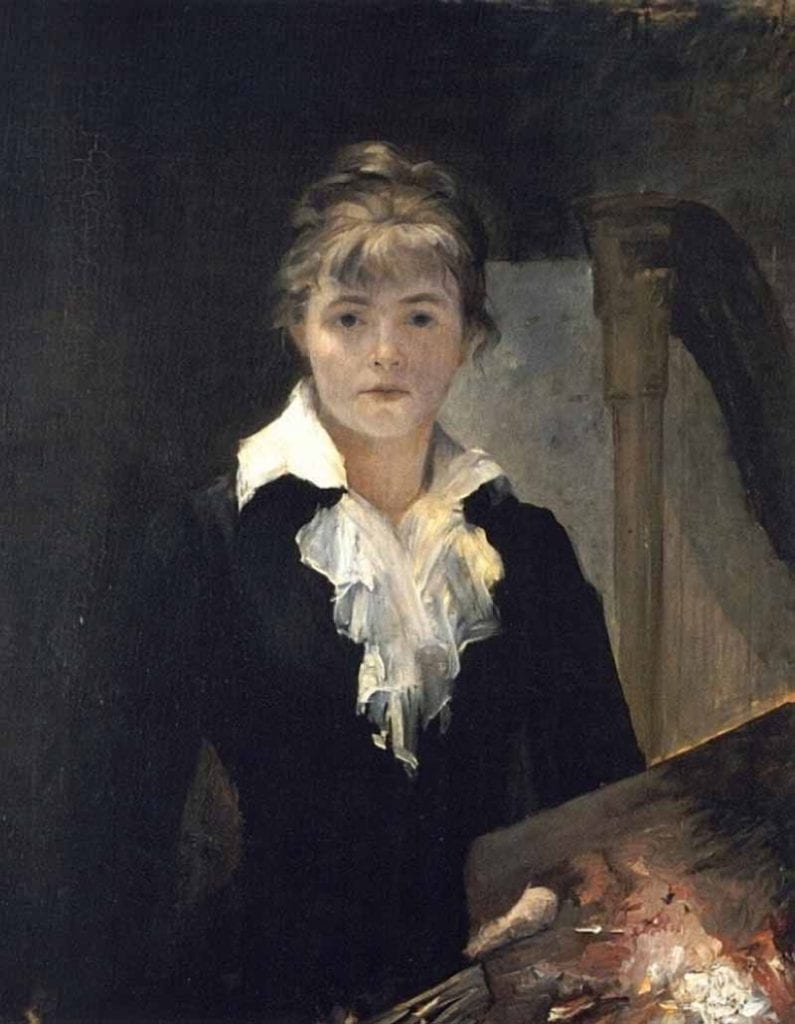
The self-portrait is probably the most interesting tradition among women artists. Often women artists portray themselves as artists, or rather claim their status as an artist though self-portraiture; paintings of other women artists painting are a related tradition, involving a kind of vicarious self-portraiture. This painting gives us both sides of the tradition: the artist, Marie Baltshirtseff, is in the foreground, but we also see a whole studio of women art students.
It also shows us a key space in the history of women in the arts: the Académie Julian, one of the only places in 19th century Paris that gave rigorous training to women artists and consequently the alma mater of many women painters, such as Cecelia Beaux (but also non-French artists in general, e.g. John Singer Sargent). Though the Académie Julian allowed women to study nudes (at least semi-nudes), it was considered too scandalous for male and female students to paint nudes together; as a result, we see an all-female class in this scene, painting a semi-clothed boy posing as St. John the Baptist. Interested in the history women artists? Come on the Nasty Women tour of the Metropolitan!
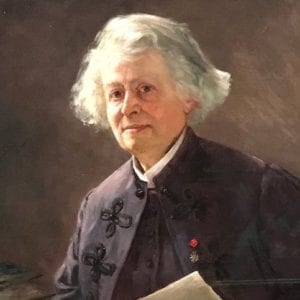
One of the great animal painters of the 19th century, Rosa Bonheur, portrayed by her life-partner, the American painter Anna Klumpke. For once, Bonheur is wearing women’s clothing, but her gown’s monochrome simplicity and its jacket-like bodice, along with her strong features and lack of make-up, coiffure etc. certainly make her somewhat gender-ambiguous. In fact, it’s hard to say what modern category (if any) Bonheur fit in. A trans activist recently suggested to me that she may have been intersex, which I consider interesting. Whatever the case was, however, she certainly was an early example of a modern, unmarried career woman—and the painting absolutely conveys her strength and independence.
As you walk around any museum, you will see portraits that include far more fashion than person. Here is a great Renaissance gentleman with the vast mink collar, his elegant double brocaded with gold thread, his two gold chains, his beautifully manicured hands and probably perfumed gloves, the intricate badge on his hat and the large, assertive (and expensive) feather. We always think it’s sad when we don’t know who portraits like this represent, since they obviously put so much effort into dressing up and having a picture made of their fanciest duds…. Come let us show you how art museums are a giant fashion show on the Fashion and Beauty tour!
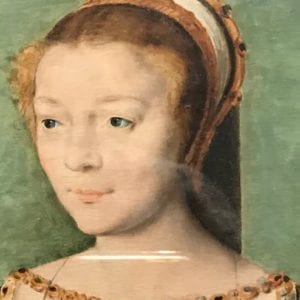
People often ask if our tours change over time, and the answer is absolutely yes, they change—both because the museum’s displays change, and because we discover things about the artworks. Here for instance is a portrait of a royal mistress that just came onto display at the Met. It isn’t certain who the artist is, but the subject is clearly Anne de Pisseleu, the Duchesse d’Étampes, who was one of the most important mistresses of François I, France’s most important Renaissance king. Anne was a typical Shady Lady: she was famously beautiful, but also famously intelligent. In fact, she was called “the most beautiful of the learned, and the most learned of the beautiful.” It was also typical of the French court that François married her off and gave her husband a title: the French always wanted their royal mistresses to be titled and married (perhaps to prevent their children from making claims on the throne). Want to know more about the Shady Ladies of art and history? Come on our Shady Ladies tours!