At the end of this very real annus terribilis, I want to say a few words to you, our loyal readers and attendees. Above all, thanks! Thanks for keeping Shady Ladies Tours alive by reading our blog, attending our Zoom tours, watching our YouTube videos, contributing to our fundraisers—in short, for being a fabulously loyal community. When the pandemic hit the US, in March, it seemed likely to kill the company completely. Who would have thought that 9 months later, as the pandemic continued to rage, we would be putting on our 18th Zoom tour, with audiences regularly over 100, and have gathered over 28,000 views for our videos? It’s been a hard year, but ours is a tiny, flourishing corner. And we have a lot more coming after the holidays! Want to find out more? (more…)
Category: nasty women

Paris Women’s History in Père Lachaise
Bold and sexy women must always have existed everywhere, but in history they seem to be a French specialty. There are a number of places where you can learn about them in Paris. The Louvre and Orsay museums are great, for instance, or the royal palace at Versailles. But if you are interested in the colorful sides of Paris women’s history, don’t miss Père Lachaise Cemetery!
Père Lachaise, founded under Napoleon in 1804, was Paris’s first non-sectarian cemetery. It was also the first garden cemetery, a 19th century trend that brought us London’s so-called Magnificent Seven cemeteries, New

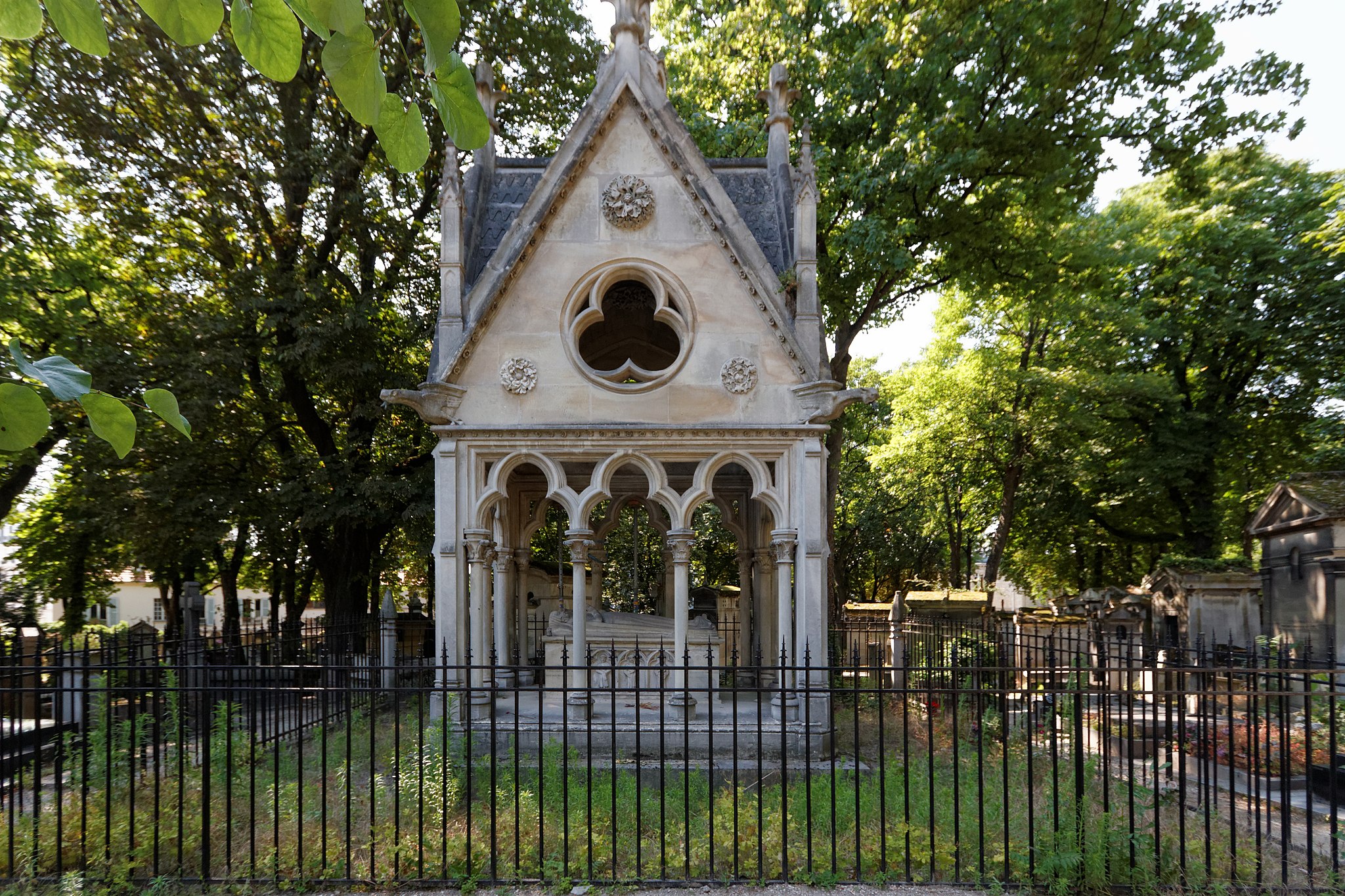
Père Lachaise Cemetery York’s Green-wood, Boston’s Mount Auburn, and so on. These cemeteries were intended as parks, where the public could stroll and even picnic. And one of the attractions (aside from groves, ponds, etc) was meant to be the magnificent tombs of well-known people. Indeed, the founders of Père Lachaise jump-started this aspect by transferring some famous tombs there, including the one you see above. Thus is the joint tomb of the iconic romantic couple of the Middle Ages, theologian Abélard and his abbess wife Héloïse.
And they were certainly successful in attracting the tombs of the prominent—including many prominent women. There are certainly famous men in the cemetery, such as (to start with composers) Chopin, Rossini, and Bizet. And the two most visited tombs are those of English-world celebs Oscar Wilde and Jim Morrison. Yet there are many fascinating women buried here as well. A short list would be long but would have to include: Sarah Bernhardt, Isadora Duncan, Gertrude Stein and Alice B Toklas, Colette, Maris Callas, and Edith Piaf. These are the kind of bold and sexy women that makes Paris women’s history so special and intriguing.
Here are three of my favorite tombs in Père Lachaise. Two are of women, and one is (as I will explain) important to Parisian women.
The racy writer
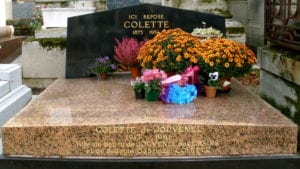
I’ll start with one from my list above: the tomb of Colette, which is right near the main

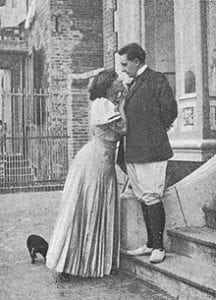
Colette’s tomb entrance to the cemetery. Colette was an astonishing person. She is probably the most famous French woman writer today. Her four early Claudine novels are very popular in France. And her last book, Gigi, is well-known around the world—mainly, no doubt, because of the movie, starring Audrey Hepburn—whom Colette herself discovered. She was also a racy person. After she had left her first husband (who discovered her gift for writing but kept the copyrights to her first books for himself) she created a scandal by carrying on an affair with a cross-dressing aristocrat called Mathilde de Morny, and generally known at the time as Max or uncle Max. The scandal reached its peak when Colette and Max

Colette and Max kissed on stage at the Moulin Rouge—a pretty bold gesture for 1907! Colette kept most of her raciness for her writing, however, in which her biggest themes are lesbianism and courtesans—the high class sex workers who were so important in Belle Epoque Paris’s life and of whom Colette’s Gigi is the most famous example.
The cross-dressing painter

A thruple in death: Ducas, Bonheur, Klumpke Next is another tomb of a bold and racy woman, the painter Rosa Bonheur. Bonheur is not famous today, but before the Impressionists began the turn toward abstraction that typifies modern art, she was a big star of the art world. An example in an American museum is the vast hyperrealistic The Horse Fair that fills a wall at the Metropolitan Museum.
Bonheur probably interests modern viewers more as a personality than as an artist, though. She was one of those artistic 19th century women who lived her life in households consisting of two women—what today historians call ‘Boston marriages.’ It is impossible for us to know what went on in private, but one tends to assume that the women in these ‘marriages’ were mostly what today we would call lesbians. But Bonheur was not only probably a lesbian, she was also what we would call gender-queer. She was strikingly non-feminine and often dressed in men’s clothing. She lived in two Boston marriages: the first with a woman called Nathalie Ducas, the second (after Ducas’s death) with an American painter called Anna Klumpke.

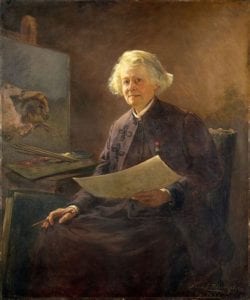
Bonheur by Klumpke I am giving you two pictures. One is a striking portrait of the elderly Bonheur by Klumpke, the other the Ducas family tomb, where not only Nathalie is buried, but also Bonheur and Klumpke both (as you can see from the plaques on the front).
The fertility cult
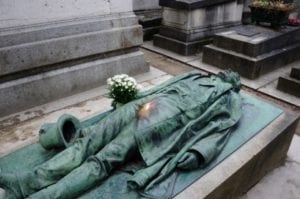
Finally, let me show you one of the sights every Parisian knows in the cemetery: the tomb of Victor Noir. Noir a young left-wing journalist who was shot by Prince Pierre Bonaparte, and his tomb long served As the center of many left-wing rallies. You might think you’re seeing things, but no, that really is a realistic death erection in his trousers,

Victor Noir’s tomb and yes, it is rubbed clean of verdigris. If you look carefully, you can see that his lips are also clean. That is because Victor, with his erection, serves as a fertility cult place-of-worship for Parisian women who want to pray to find a boyfriend, get pregnant etc. The tradition is that you kiss his lips, leave flowers in his hand (as you can see in the photo) or hat and rub his erection. I have heard from some gay friends that they pray to Victor Noir as well!
So if you want to know about Paris women’s history—the history of bold and sexy women that really is one of the things that makes Paris Paris—don’t only visit the museums and Versailles. Take a stroll around Père Lachaise as well! Or, if you can’t go to Paris (because none of us can go anywhere right now!) take Shady Ladies Tours’ Père Lachaise tour on Zoom the next time we offer it.

Nasty Women of History and Art
It seems unbelievably dated, but people are still calling ambitious, intelligent women “nasty women.” As if that could hurt anyone’s feelings in 2020! In fact, like many other outdated insults, it has the opposite effect. Many women today are are taking the term on (as lesbians took on the term ‘dyke’) and calling themselves “nasty women” in sarcastic protest. (more…)

Watch: Virginia Hall America’s Most Successful Female Spy
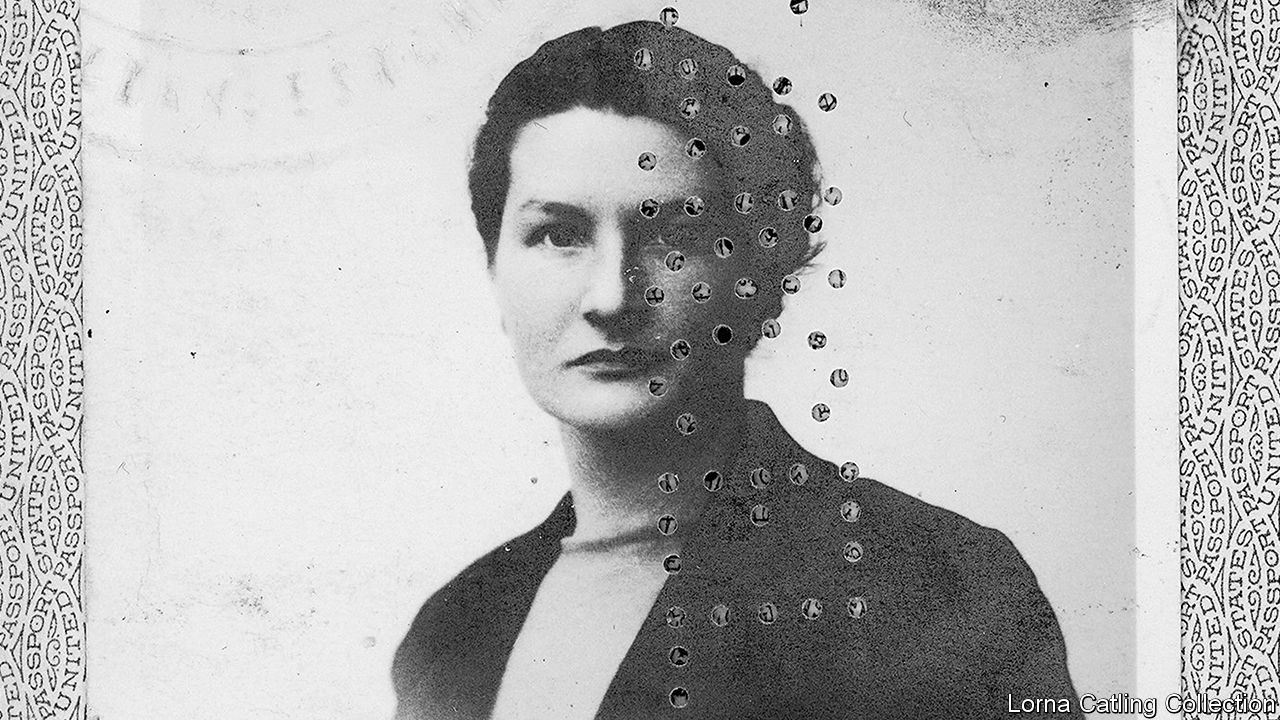
Virginia Hall, a one-legged socialite from Baltimore whom the CIA Museum would later hail as the office’s most successful American female spy of the Second World War. She was the most highly decorated female civilian during World War II. Watch and learn more about this heroic woman of history!
Virginia Hall is one of the most important American spies most people have never heard of.
Virginia Hall, a one-legged socialite from Baltimore whom the CIA Museum would later hail as the office’s most successful American female spy of the Second World War. She was the most highly decorated female civilian during World War II. Watch and learn more about this heroic woman of history!
Posted by Nasty Women Tour on Sunday, April 21, 2019

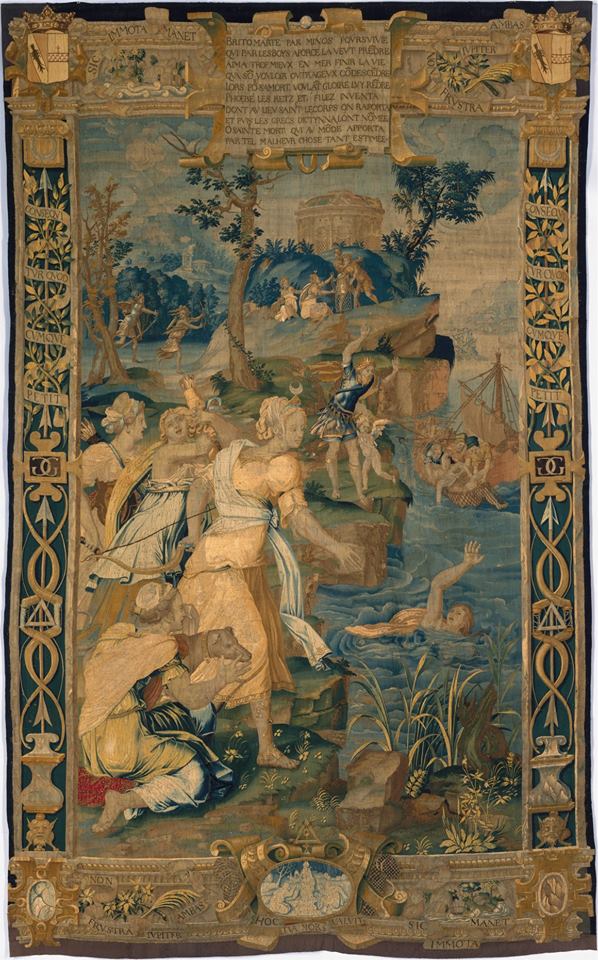
Tapestry of Diane de Poitiers
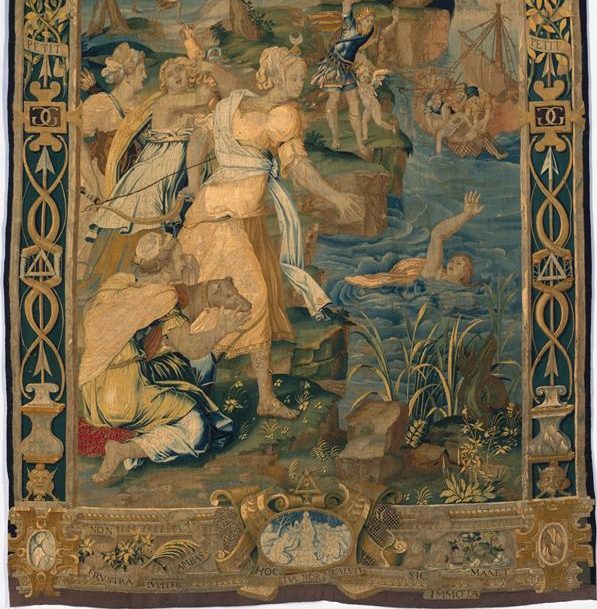
Diane de Poitiers, represented on this wall hanging as the goddess Diana, was so powerful in France when she was the mistress of King Henri II that they often signed his correspondence with one word: HENRIDIANE. Find out more about powerful women in history on the Nasty Women tour!


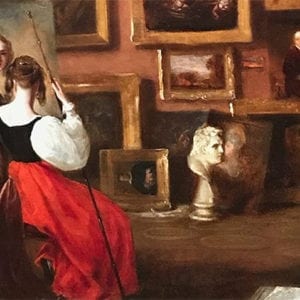
Painter Mary Ann Alabaster
One of the most important traditions among women painters is the self-portrait in which the artist claims her status as an artist. This is a 19th century English example, by the painter Mary Ann Alabaster, who shows you herself painting a portrait of herself (a self-portrait within a self-portrait) surrounded by her works in different genres. (more…)
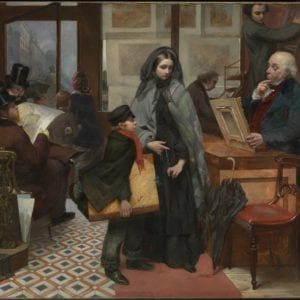
Seen at the Tate: Nameless & Friendless by Emily Mary Osborn 1857
Emily Mary Osborn was one of the most important artists associated with the campaign for women’s rights in the nineteenth century. The daughter of a clergyman, she was brought up in Kent and Essex until 1842 when the family moved back to London. It was here that she trained as an artist at Dickinson’s academy in Maddox Street and then at Leigh’s in Newman Street. During the 1850s Osborn established a reputation as a genre painter specialising in figurative subjects of ‘unpretending character’ – the most significant of which were pictures of modern women in pathetic situations, similar to works by Richard Redgrave and Rebecca Solomon. Home Thoughts, which was painted in 1856 and exhibited at the Royal Academy that same year, was followed by her most famous work Nameless and Friendless in 1857. A full-scale, squared-up preparatory design for the latter exists in the Ashmolean Museum in Oxford and a smaller version in oil in York Art Gallery.
(more…)19th Century Painter Rosa Bonheur
One of the great animal painters of the 19th century, Rosa Bonheur, portrayed by her life-partner, the American painter Anna Klumpke. For once, Bonheur is wearing women’s clothing, but her gown’s monochrome simplicity and its jacket-like bodice, along with her strong features and lack of make-up, coiffure etc. certainly make her somewhat gender-ambiguous. In fact, it’s hard to say what modern category (if any) Bonheur fit in. A trans activist recently suggested to me that she may have been intersex, which I consider interesting. Whatever the case was, however, she certainly was an early example of a modern, unmarried career woman—and the painting absolutely conveys her strength and independence.
The feminist concept of the “male gaze”
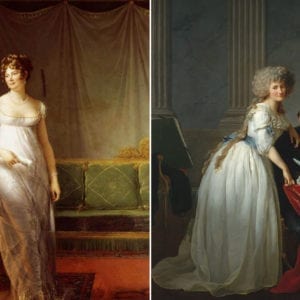
The feminist concept of the “male gaze” is useful in art criticism. The concept originally comes from film studies, where it is used to discuss the fact that men traditionally controlled the camera, of which women were an object. Men certainly also controlled the brush through most of the history of Western painting, and the women in paintings generally acknowledge this. As the art historian John Berger said, women in painting don’t usually look out at the viewer: they aren’t considering the viewer, but considering how the viewer sees them. They have an inward gaze, rather than an outward gaze. But painters can also violate this “rule” (more a tendency really) to depict a woman who has power or confidence.
Two paintings that are diagonally across from each other at the Metropolitan Museum make this clear. On the one hand, we have Gérard’s portrait of the Princess of Talleyrand, a courtesan who became Talleyrand’s mistress and then his wife. She was considered very beautiful in her time and is dressed in the latest Empire fashions, and she looks down and to the side in her portrait. Her gaze avoids the viewer’s: she is absorbed in her own thoughts, or her own coquetry, it’s unclear which. Across the gallery is David’s double portrait of the great scientist Lavoisier and his wife, Marie-Anne Paulze. Here the male inside the painting definitely does not control the gaze: he looks up at his wife questioningly, while she does not return his gaze (though she puts her hand on his shoulder with a gesture of intimacy unusual in painting). Instead she turns to look out directly and confidently (though not aggressively) at the viewer: it is she who communicates with the world on behalf of this couple. And in fact this portrays something real about this couple. Paulze had many public-facing characteristics that Lavoisier lacked: she spoke many languages and could inform Lavoisier about the scientific literature of the whole of Europe. And she was also his lab illustrator, explaining his/their experiments to the world through the visual arts. Look at the women you see in the art museum the next time you go. Do they look out at the viewer, or not, and why?
https://www.facebook.com/events/724999504353889
Nasty Women of the MFA Boston
The Museum of Fine Arts, Boston is of course one of the world’s great museums. It is also a great place for a women’s history tour. There are very few of the courtesans or mistresses that make up our Shady Ladies tour in New York: I suspect that the Boston collectors of the 19th century were too prudish to buy pictures on themes they knew were racy. But the museum has a great collection of what we’re calling (ironically) “nasty women“—feisty, ambitious women from many periods of history. (more…)